Most hosting pages stop at “fast and secure”. A WordPress hosting stack is the chain of layers every request passes through, and each layer settles something different: how far the request travels, what gets blocked on the way, how many visitors are served at once, and how quickly the database replies.
This breakdown follows one request through InstaWP’s managed WordPress hosting, from the InstaCDN edge down to MariaDB, then covers what each plan gets, how the bill is worked out and where AI agents plug in. The timings come from our own August 2026 benchmark run, and the plan details from our pricing page.
- Test the logged-in pages, not the homepage. Most anonymous page views are answered at the InstaCDN edge; carts, checkout and wp-admin travel the whole stack.
- Each site has its own Linux user, document root, database and PHP-FPM pool, so another site’s PHP never runs in yours.
- The block editor builds in 56 ms on new-generation servers, against 149 ms on the previous generation (median of 100 requests, 21 August 2026).
- Plus ($9 a month) is the first plan with the full stack: Premium edge, Advanced InstaShield, object cache and daily backups kept 30 days.
- PHP workers set capacity, not single-page speed: 1 on Sandbox, up to 10 on Elite.
- SSH, WP-CLI, Git, PHP 7.4 to 8.5 and in-site MCP are on every plan, including the $2 sandbox.
Table of Contents
What Is the InstaWP Hosting Stack, Layer by Layer?
A request to an InstaWP site goes visitor, InstaCDN edge, InstaShield firewall, Nginx, PHP-FPM, object cache, then MariaDB. Most anonymous page views are answered at the edge and never reach the server. Logged-in, cart and admin requests travel the whole path, which is why the lower layers matter as much as the CDN.
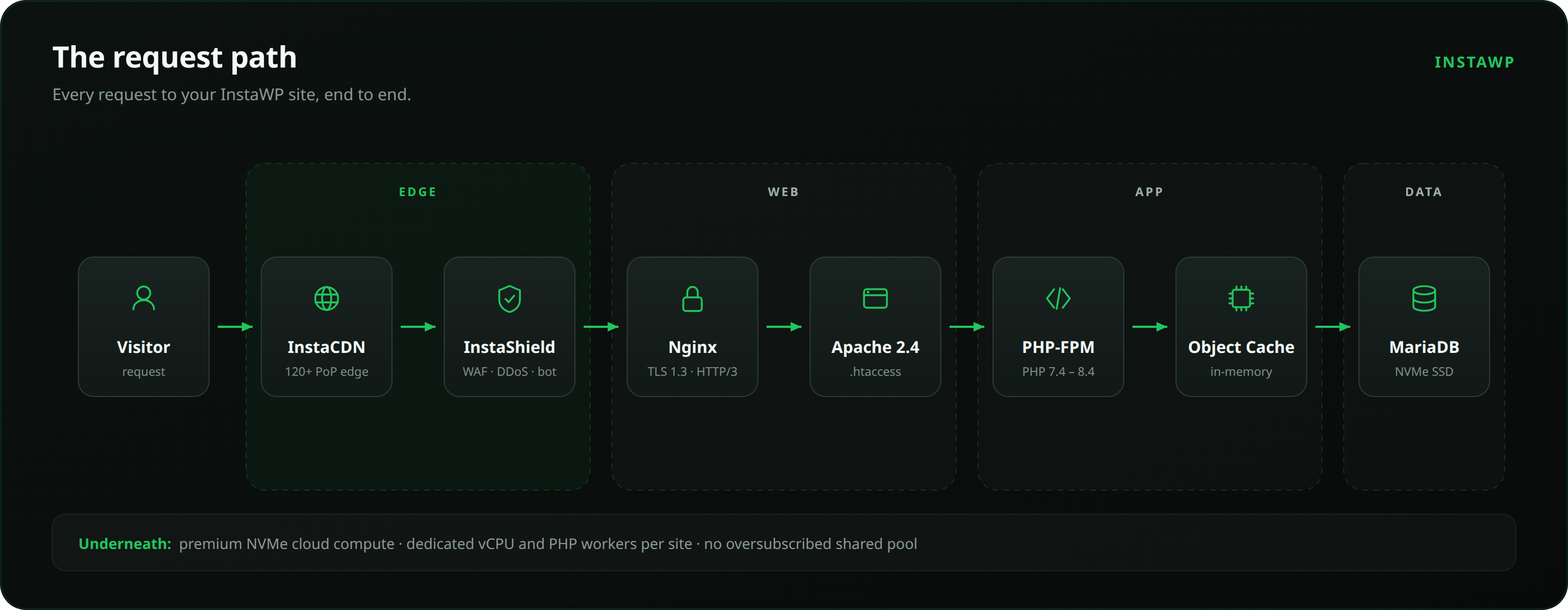
Under every site sits the isolation that makes it managed hosting rather than shared hosting: each site gets its own Linux user, its own document root, its own database, and its own PHP-FPM pool and socket. One site’s PHP processes are never mixed into another site’s pool.
1. Compute: how fast are InstaWP servers?
WordPress builds each page in a single PHP process, so the speed one CPU core can deliver matters more than the core count. That is the number InstaWP optimized for when it specified its new generation of servers.
What is in a new-generation server, as published in our WordPress hosting benchmark:
- CPU: 8-core AMD Zen 5, 16 threads
- Memory: 64 GB DDR5
- Storage: NVMe SSD in a ZFS mirror
ZFS makes snapshots cheap, which is what lets backups run daily without slowing the site. On 21 August 2026 InstaWP built the same WordPress 7.0.4 site, with no plugins and no page cache, on a new-generation server and on a typical previous-generation one, then timed how long each server took to build each page. These are medians of 100 requests per task:
This is server think time, measured on the machine itself, so it excludes network distance, images and third-party scripts. The full method, the percentiles and the raw data are in the benchmark report.
You can check it with a tool we did not write. The free WP Benchmark plugin from WordPress.org scored the new-generation server 9.8 out of 10, against 7.3 on the previous generation, on the same site and the same day.
2. Edge: what does InstaCDN do?
InstaCDN is the first layer a visitor reaches. It caches your pages and assets on a global edge network across six continents and serves each visitor from a location near them, so most requests never make the round trip to your origin server.
- Basic edge (Starter): a smaller set of edge locations with 10 GB of CDN bandwidth a month, fine for regional traffic.
- Premium edge (Plus and above): the full global network, with 30 GB on Plus, 75 GB on Pro, 125 GB on Turbo and 200 GB on Elite.
- Purging: clear a site’s cache in one click from the dashboard, or from the API.
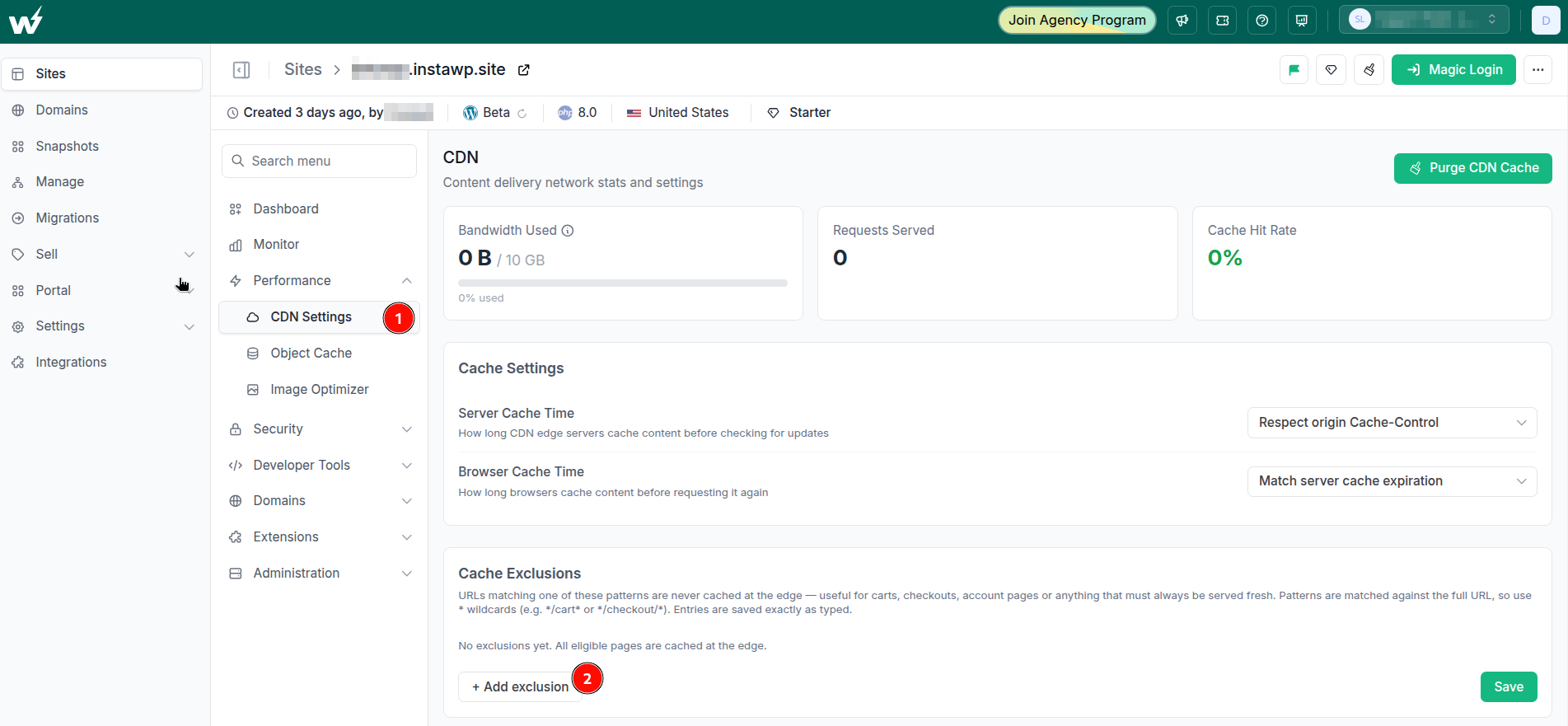
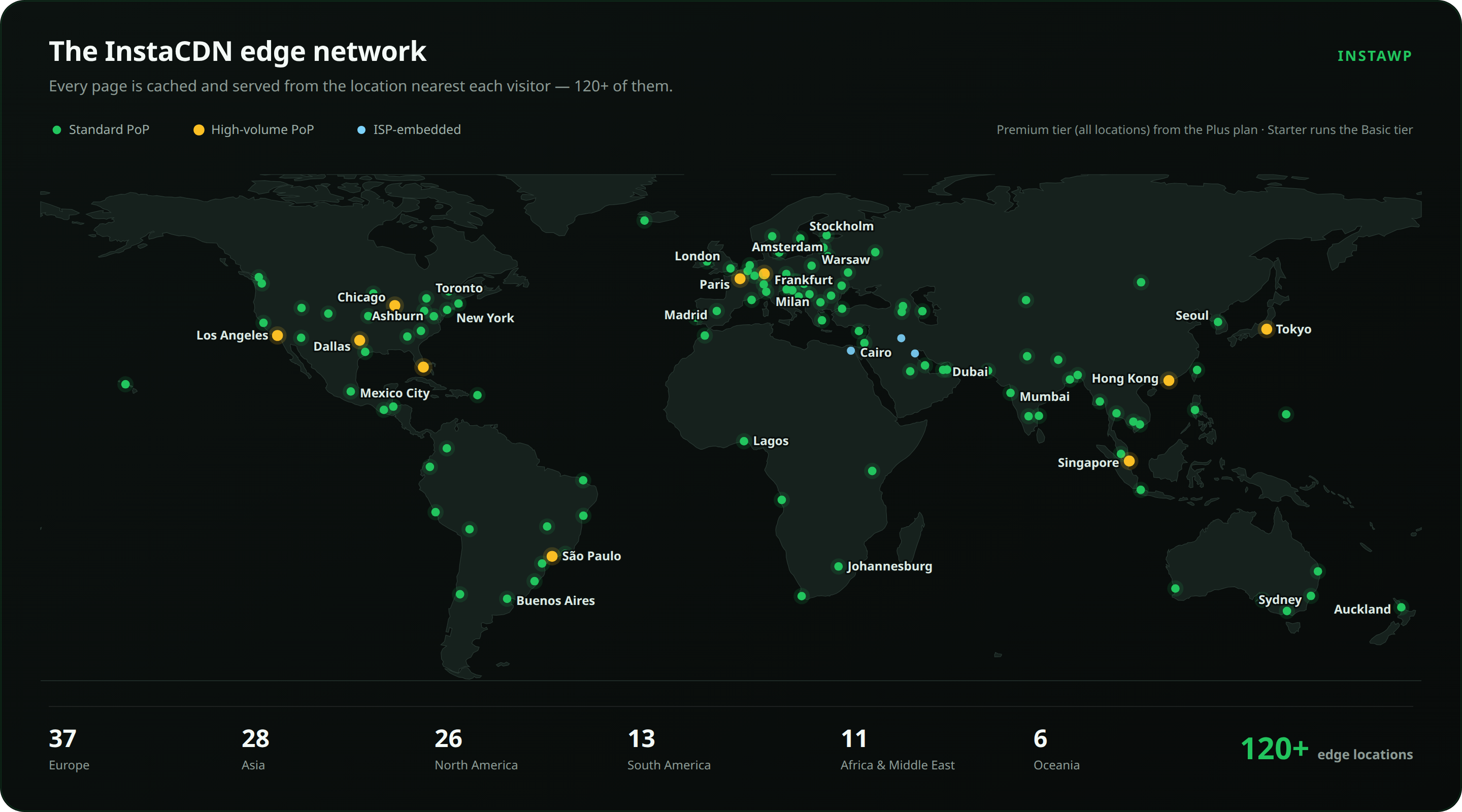
Changing plan does not touch your DNS. The edge coverage changes with the tier and your domain keeps working. More detail is in InstaCDN explained.
3. Security: how does InstaShield protect a site?
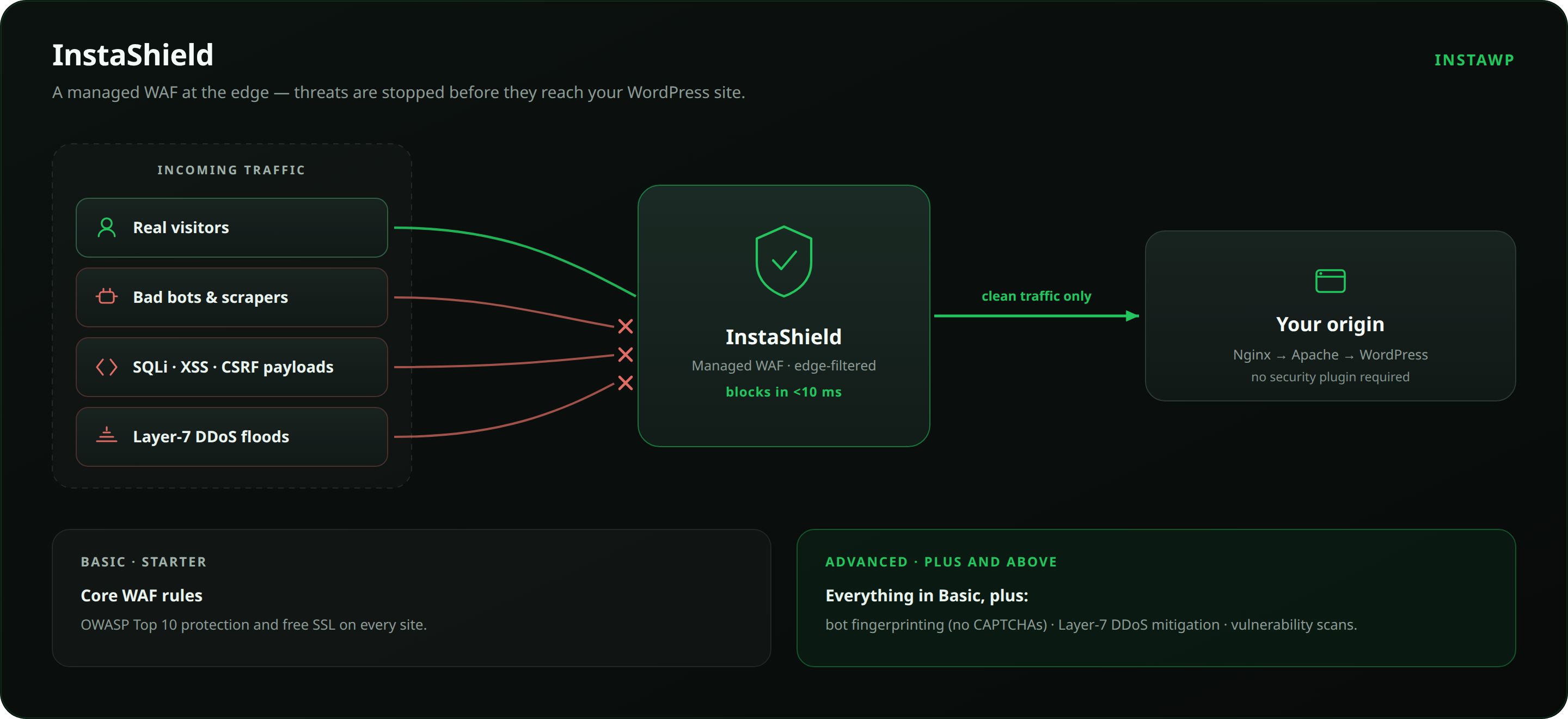
InstaShield is a managed web application firewall at the edge, in front of your origin. It filters attacks before they reach WordPress, so you do not need to configure a security plugin or wire up a third-party WAF.
- Basic (Starter): managed WAF rules based on the OWASP Top 10, DDoS mitigation and free SSL.
- Advanced (Plus and above): adds edge bot detection, custom WAF rules and stronger DDoS mitigation.
Bot detection on Advanced uses browser fingerprinting rather than blunt IP blocklists, so real visitors are verified in the background without a CAPTCHA. Every layer can run in Log or Block mode, which lets you review what it would stop before you enforce it. See InstaWP Shield for the full breakdown.
4. Web layer: why Nginx in front of Apache?
InstaWP runs a hybrid web layer because choosing only one costs WordPress something.
- Nginx at the front: TLS 1.3 termination, HTTP/2, Brotli and GZIP compression, and static asset delivery.
- Apache 2.4 (Event MPM) behind it: dynamic PHP via
proxy_fcgi, with full.htaccesssupport.
The .htaccess support is the reason. A pure Nginx host breaks a long tail of WordPress plugins that rely on rewrite rules and redirects. This way you get Nginx at the front door and the compatibility WordPress assumes.
5. PHP runtime: which PHP versions does InstaWP support?
- PHP 7.4 through 8.5, chosen per site from the dashboard rather than a platform-wide default. New sites start on PHP 8.2.
- Every paid plan includes a 512 MB PHP memory limit.
- A php.ini editor in the dashboard: change
memory_limit,upload_max_filesize,max_execution_timeand the rest yourself, with no support ticket. - Modules including imagick, redis, ionCube Loader, memcache, pdo_mysql, intl and curl.

WordPress itself recommends a currently supported PHP version (see the WordPress requirements and PHP’s own supported versions list), and per-site switching means one legacy site never holds the rest back.
6. Object cache: when does it help?
Page caching only helps anonymous visitors. As soon as someone logs in, adds to cart or opens a dashboard, WordPress goes back to the database for every query it cannot remember.
InstaWP’s Redis-compatible object cache, built on Valkey and included from the Plus plan up, keeps those query results in memory. It is enabled for you, with no plugin to configure. WooCommerce stores, LMS platforms and membership sites gain the most, because their busiest pages are exactly the ones a page cache cannot serve.
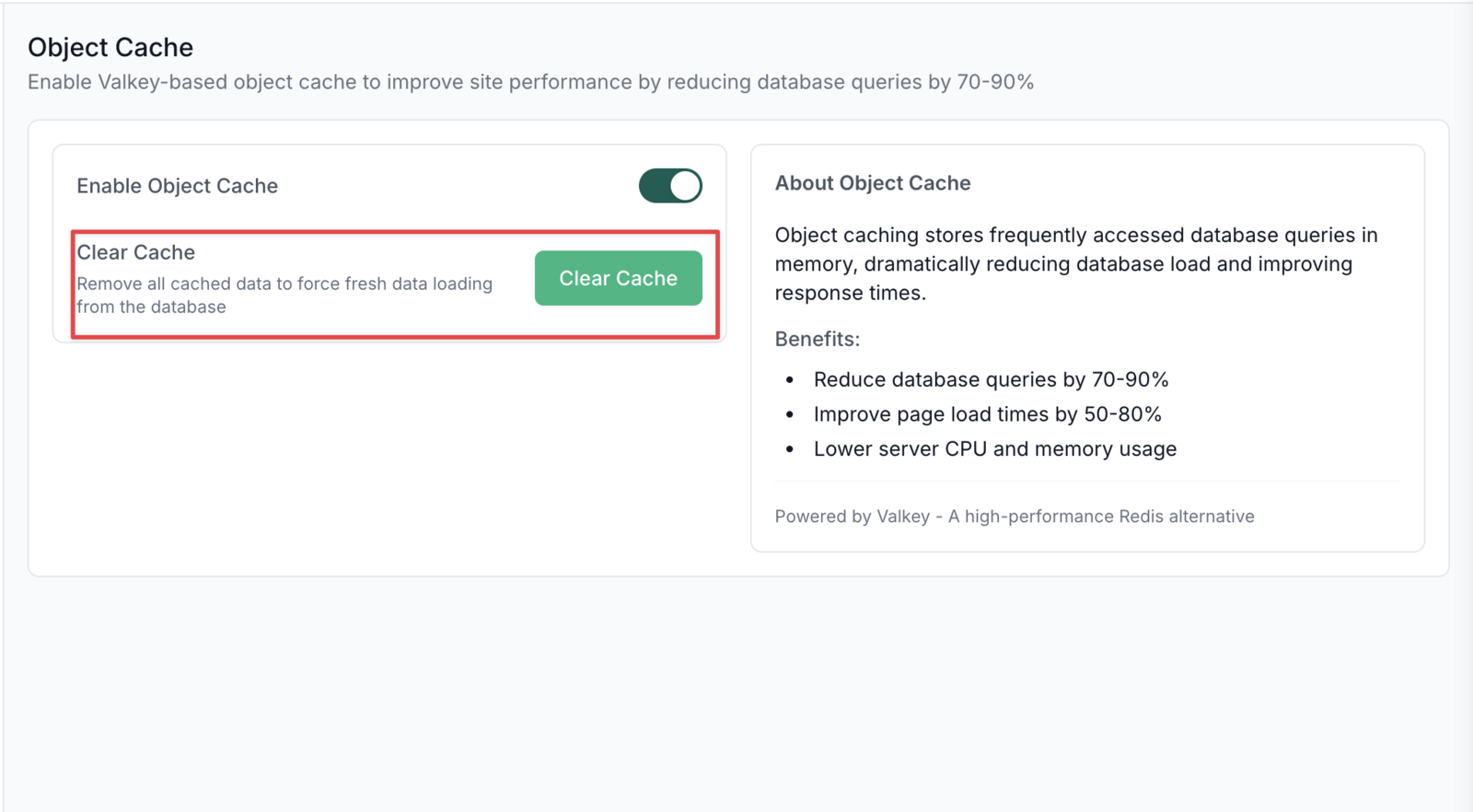
Object cache and faster cores solve different halves of the same problem. Object cache spares WordPress repeat database work. Faster cores speed up everything that still gets built from scratch: the editor, the dashboard, search and checkout. That is why the block editor builds in 56 ms on the new servers, against 149 ms on the old ones. See InstaWP Object Cache for when to turn it on.
7. Database and storage: what runs under WordPress?
MariaDB 11.4, a drop-in replacement for MySQL, on NVMe SSDs, running on Ubuntu 24.04 LTS. Slow database reads are the most common reason a WordPress site “feels slow for no reason”, and fast local NVMe in the region you chose fixes most of it.
What Does Each InstaWP Plan Get?
Each InstaWP plan is set per site, not per account, and each tier adds PHP workers, storage, CDN bandwidth and features. A $5 brochure site can sit next to a $25 store in the same dashboard, each billed for what it is.
Object cache, bot protection, the vulnerability scanner and Advanced site management are included from Plus. Built-in staging and image optimization are included from Pro. The pricing page has the live matrix, and InstaWP site plans explained helps you pick one.
You can change a site’s plan on any day, up or down, and billing prorates from that day. The site keeps its URL and data, so there is nothing to migrate.
Where are InstaWP servers, and what are PHP workers?
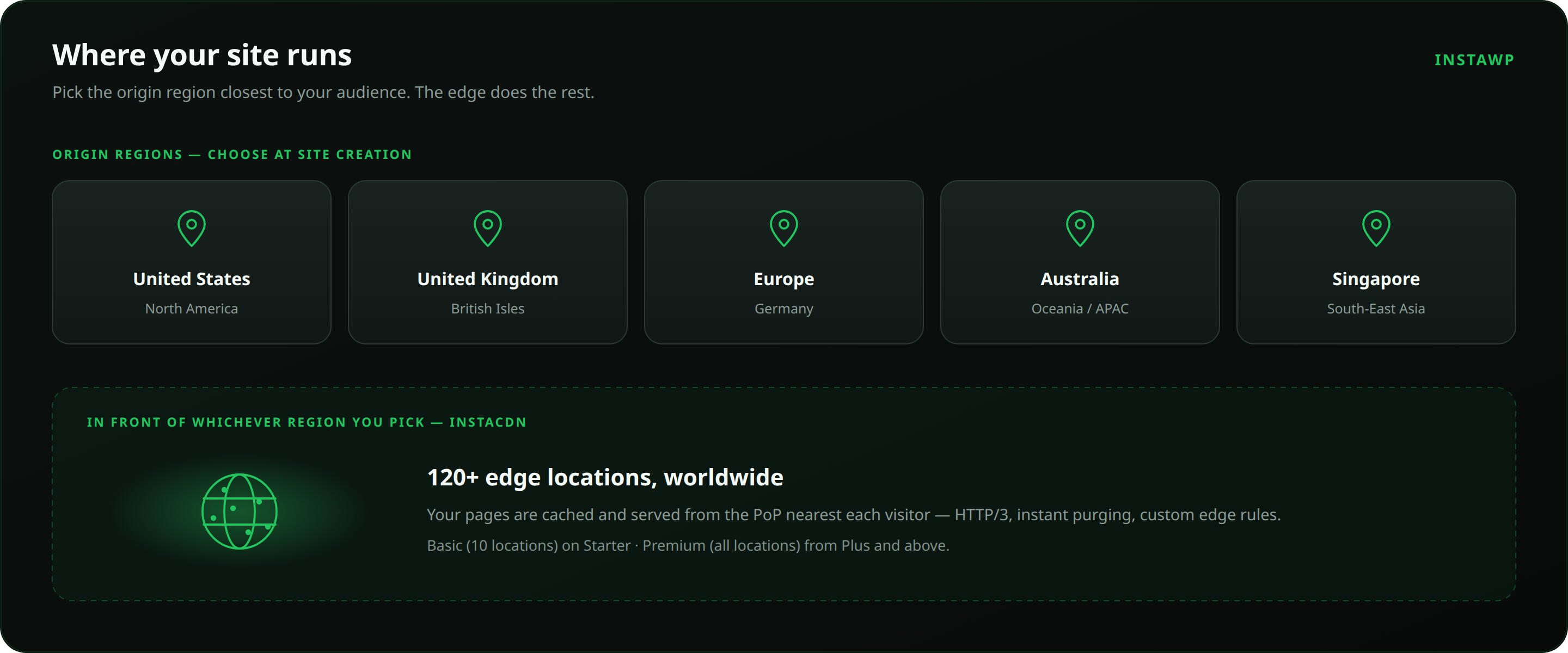
You choose the region when you create the site, so it runs close to your audience: United States, United Kingdom, Europe (Germany), Australia or Singapore.
A PHP worker is one process handling one uncached request at a time. Each InstaWP site has its own PHP-FPM pool sized by its plan, from one worker on Sandbox to ten on Elite. Workers set how many visitors the site can serve at once; they do not make a single page faster. That concurrency is what carries a checkout page through a traffic spike.
What Comes With Every InstaWP Plan?
Every InstaWP plan, from the $2 sandbox to the $45 Elite site, gets the full developer toolkit. Tiers change capacity and hosting features, never basic access.
- SSH, SFTP and WP-CLI: full shell access on every site, from the browser terminal or your own machine.
- Git, Composer and your own tooling: deploy from GitHub, GitLab or Bitbucket, including GitHub Actions. See the developer tools.
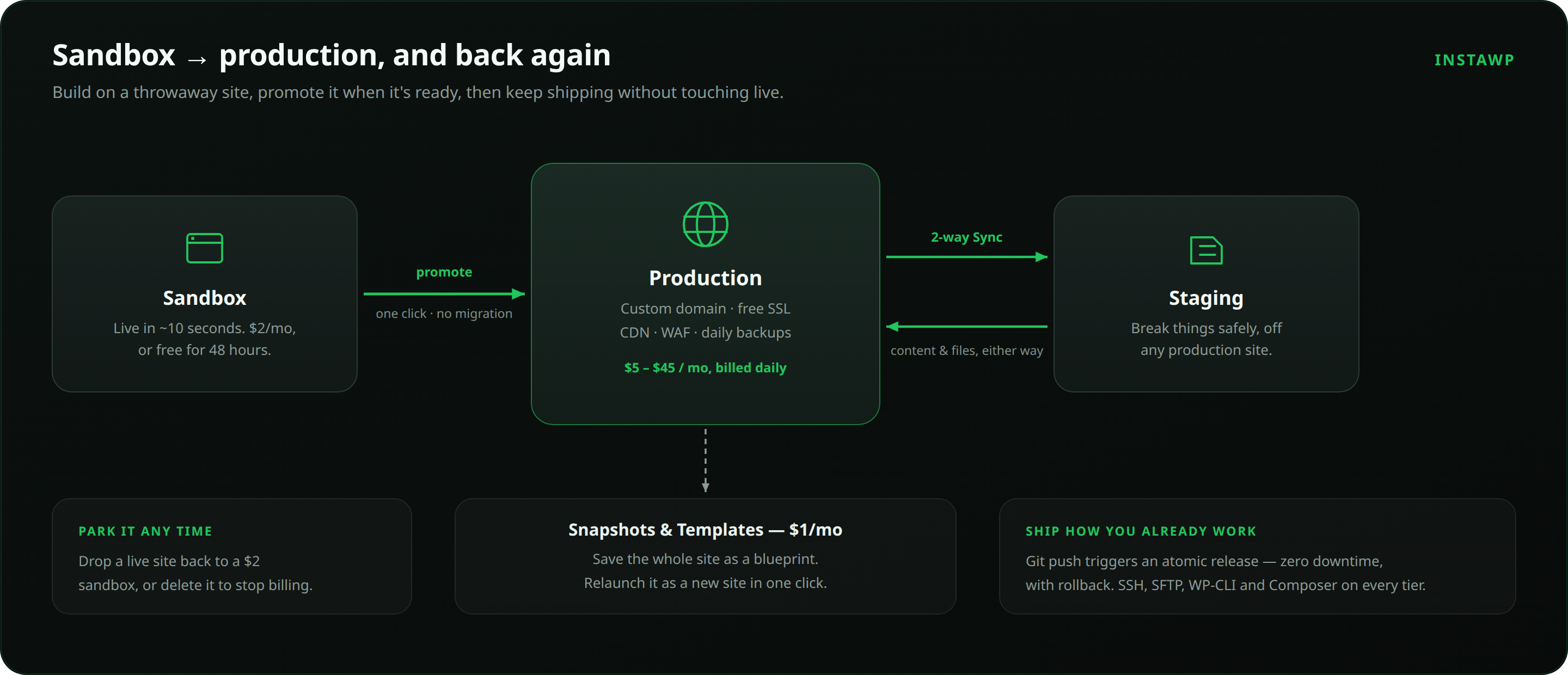
- One-click sandbox to production: build on a sandbox and promote it when it is ready, on the same URL, with no re-migration.
- Custom domains and free SSL: certificates issued and renewed for you, on Starter and above.
- .htaccess and php.ini: yours to edit.
- Live logs: read them from the dashboard while you debug.
- Free migration in: AI-assisted and self-serve, and your old site keeps serving visitors until you switch DNS.
- Human support: WordPress people on every plan, with answers in minutes.
Can AI Agents Run WordPress Sites on InstaWP?
Yes. InstaMCP, available on every InstaWP plan, exposes a WordPress site over the Model Context Protocol, so an AI agent such as Claude can work on a real site directly. It can read and write content, inspect the database, manage plugins and themes, read logs and diagnose a fatal error, through scoped, revocable tool access.
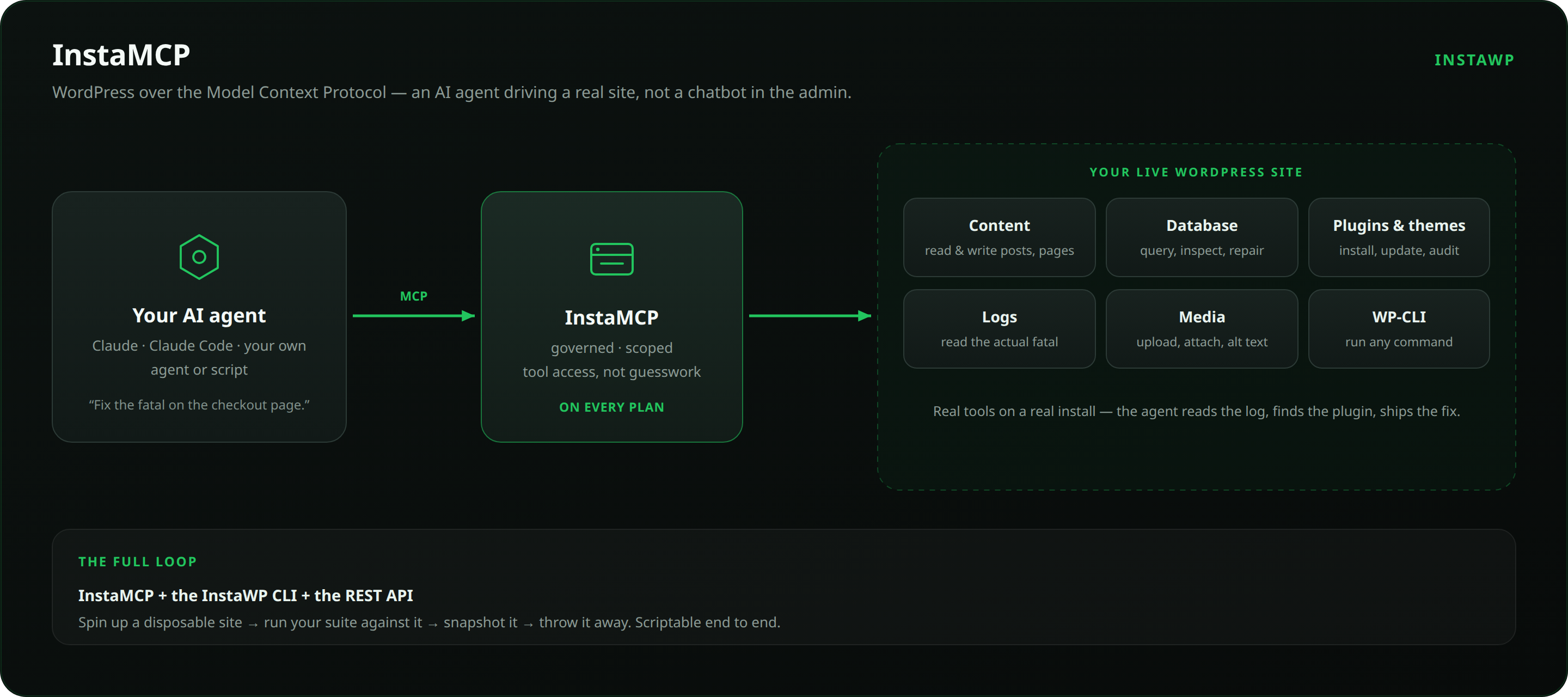

Pair it with the InstaWP CLI and the REST API and the whole platform becomes scriptable: spin up a disposable site, run a test suite against it, snapshot it, and throw it away. That is the loop AI-assisted development needs. The WordPress MCP server page covers setup.
Because MCP is on the $2 Sandbox too, you can let an agent loose on a disposable copy of a site before you connect it to production.
What Is Built In Beyond Hosting?
Beyond the stack itself, InstaWP includes site management, image optimization, staging, snapshots and backups, each included from a specific plan.
InstaManage: site management (included on Plus and above)
Delivered through the InstaWP Connect plugin, which is pre-installed on your site:
- Uptime and SSL monitoring: multi-region checks, response-time history, and email and Slack alerts when a site goes down.
- Performance scanning: mobile and desktop scores for each site.
- Vulnerability scanning: known CVEs in your plugins, themes and core, flagged so you can patch them.
- Activity logs: who changed what, and when.
- Scheduled and bulk updates, plus one-click PDF client maintenance reports.

Hosted sites on Plus and above get this Advanced tier included. Sandbox and Starter sites run on Basic management, which is free. Sites hosted somewhere else can connect free on Basic and move to Advanced for $2 a month per site. See InstaManage explained.
InstaOptimizer: image optimization (Pro and above)
Automatic WebP compression for modern browsers, delivered from the edge. It is a switch you turn on per site on Pro, Turbo and Elite, so there is no image plugin, external image CDN or extra bill. See InstaOptimize explained.
Staging, snapshots and 2-way sync
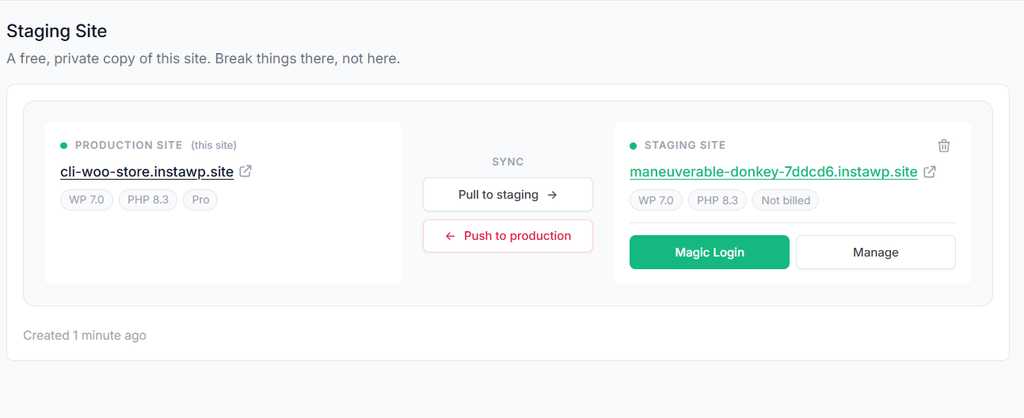
- Built-in staging (Pro and above): a full copy of the live site on its own URL, for testing the risky change somewhere that is not live. On Starter and Plus, a $2 sandbox clone does the same job. See InstaWP staging environments.
- Snapshots and templates ($1 a month each): save a full site blueprint and relaunch it in one click. This is how agencies stop rebuilding the same starter site. See snapshots.
- 2-way sync: push content and files between staging and production in either direction instead of merging by hand. It is billed by usage.
Backups and restore
Automatic off-site backups with one-click restore: monthly on Sandbox (two kept), weekly on Starter (four kept), and daily on Plus and above, kept for 30 days. Backups are stored off the server, in object storage in the same region as the site, and you can restore the files, the database or both, or download a copy. See WordPress backups on InstaWP.

How Does InstaWP Hosting Billing Work?
InstaWP bills each live site daily at its plan’s rate, totals every site in the account, and charges your card once a month. Your cost depends on how many live sites you have and which tier each one is on, so a traffic spike does not change the invoice.
- Each plan includes a monthly CDN bandwidth allowance, from 10 GB on Starter to 200 GB on Elite.
- Cut a site’s cost on any day by parking it as a $2 sandbox, or delete it to stop billing entirely. Pausing alone keeps a site on its tier and it is still billed.
- No setup fees, no cancellation fees and no annual prepay.
- Adding a card gives you $25 in free credits to spend on real sites.
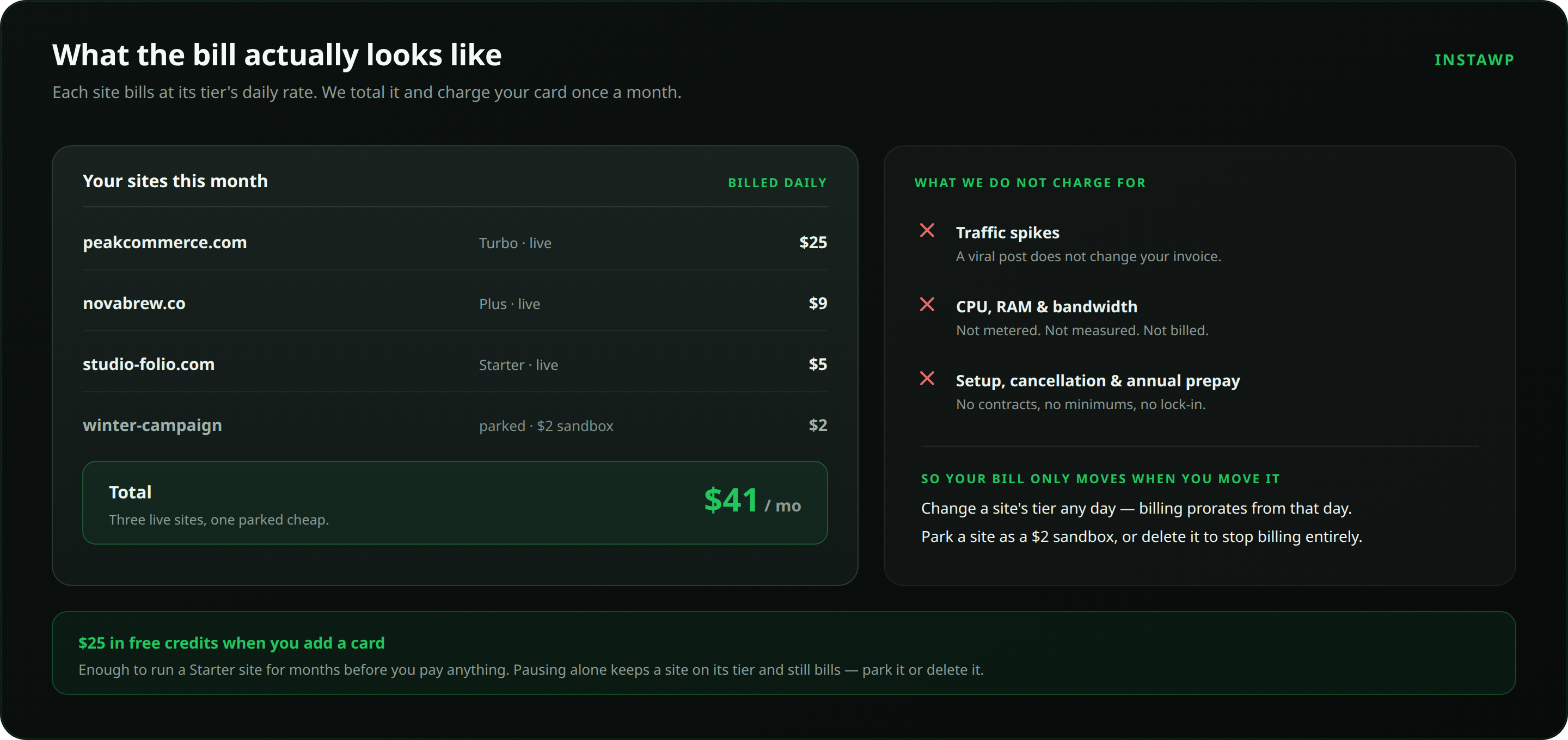
A typical agency mix of about ten client sites (five on Starter, three on Plus and two on Turbo) comes to about $102 a month. The details are in how InstaWP billing works.
Add-ons
Every production tier bundles the essentials. These are the extras you add only when you want them:
- Snapshots and templates: $1 a month per snapshot, or $2 for an instant template.
- Advanced site management for sites hosted elsewhere: $2 a month per site (included on InstaWP Plus and above).
- 2-way sync: usage-based.
- White-label domain: $5 a month to run sites on your own branded domain instead of ours.
How Do You Move a WordPress Site to InstaWP?
Moving a site to InstaWP is free and self-serve. The AI-assisted migration copies the site, verifies it, and lets you test the copy on a temporary InstaWP URL before you change DNS, so your old site keeps serving visitors the whole time.
- Start a migration at migrate.instawp.com, or import from your current host in the dashboard.
- Test the copy on its temporary InstaWP URL: plugins, forms, checkout and everything else.
- Point your domain at the new site with a CNAME (or an ALIAS or ANAME record at the root), and SSL is issued automatically.
- Shut down the old host once you are happy.
Because you test a copy before DNS moves, the switch is reversible. The only migration InstaWP charges for is moving a site off the platform, at $2 per migration. See the WordPress migration workflow.
Agencies: the Agency Program adds human-led migration help and cashback on migrated sites.
Can Agencies Resell InstaWP Hosting?
Yes. Hosting is the one recurring cost in an agency stack you can turn into profit. On InstaWP you can run client sites under your own branded domain, give clients a white-label portal through the Website as a Service platform, and keep the margin between what a site costs you and what you charge. Every resold site still gets the same CDN, firewall, backups and monitoring described above. See white-label WordPress for agencies.
Is InstaWP Managed WordPress Hosting Right for You?
InstaWP runs its own stack: a global edge CDN, a managed firewall, NVMe storage, and an isolated PHP-FPM pool for every site. You get the full developer toolkit on every tier, including the $2 sandbox, a platform an AI agent can drive over MCP, and a bill you can predict to the day. If that matches how you build, it is a good fit; if you need a fixed bundle of sites under one account, compare it with a traditional managed host first.
InstaWP is backed by Automattic and used by more than 140,000 people building WordPress sites. Ready to see the stack? Spin up a sandbox in seconds, then promote it to production when you are happy. It is billed by the day, and you can stop at any time by deleting the site.
InstaWP Hosting Stack: Frequently Asked Questions
What happened to InstaWP Live and WP Cloud?
It was InstaWP’s older managed-hosting layer, which ran on a third-party platform. It is legacy. All new sites are hosted on InstaWP’s own infrastructure, the stack described on this page.
How am I billed for InstaWP hosting?
Per site, per day, at that site’s plan rate, totalled and charged to your card once a month. Billing is not metered by traffic, so a spike does not change the invoice, and each plan includes a monthly CDN bandwidth allowance.
Do I still need Cloudflare with InstaWP?
Not for performance or security. InstaCDN and InstaShield already cover edge caching, the firewall, DDoS mitigation and SSL. You can keep Cloudflare for DNS if you prefer; just leave its proxy off for records that point at your InstaWP site.
Does InstaWP include object caching?
Yes, from the Plus plan up. It is a Redis-compatible object cache built on Valkey, enabled for you, and it helps most on WooCommerce stores and sites with logged-in users.
Can I change InstaWP plans later?
Yes, any day, up or down, from the site dashboard. Billing prorates from that day, and the site keeps its URL and data, so there is no migration.
Is migrating to InstaWP really free?
Yes. Migrating a site onto InstaWP is free, and you test the copy on a temporary URL before switching DNS. The only migration InstaWP charges for is moving a site off the platform, at $2.
Which PHP versions does InstaWP support?
PHP 7.4 through 8.5, chosen per site from the dashboard. New sites start on PHP 8.2, and every paid plan includes a 512 MB PHP memory limit.
Where are InstaWP’s data centres?
You can choose the United States, United Kingdom, Germany, Australia or Singapore when you create a site. InstaCDN then serves the site from edge locations across six continents.