Stuck between Tilda or WordPress for your next big website project? You’re not alone.
Every day, freelancers, startups, and even agencies are asking the same burning question:
“WordPress vs Tilda; which one is right for me?”
Both platforms promise speed, design freedom, and scalability.
But let’s be real; only one of them gives you full control, long-term flexibility, and a global ecosystem that powers over 40% of the internet.
So before you commit to a drag-and-drop builder or go all-in on an open-source giant, let’s break it down; features, pros, cons, and real-world use cases.
By the end of this post, you’ll know exactly which platform deserves your time, money, and digital future.
Let the battle of Tilda or WordPress begin.
Table of Contents
TL:DR: WordPress vs Tilda for Agencies
Tilda = Slick Boutique Shopfront: ⚡️ Lightning-fast, drag-and-drop gorgeousness. Perfect for quick, visual projects & landing pages. Think style & speed for smaller gigs.
WordPress = Fort Knox Vault: ? Limitless power & customizability. Scales to ANYTHING. Dominate SEO & e-commerce. Steeper learning curve, but unlocks unrivaled long-term potential & client satisfaction.
Agency Verdict: Go for WordPress to build web empires. Go for Tilda for stylish sprints. But for serious agency firepower & future-proof client success? WordPress wins.
WordPress: The Workshop of Website Development
Let’s start with the titan, the platform that powers over 40% of the internet – WordPress. Stepping into WordPress development feels like inheriting a vast, incredibly versatile workshop.
You’ve got the core framework, robust and reliable, but the real magic lies in the plugins and themes. These are your specialized tools, your custom-built machinery. Need to craft an e-commerce powerhouse? The WooCommerce plugin is your heavy-duty equipment.
Want to sculpt intricate SEO strategies? Yoast SEO and Rank Math are your precision chisels. Dreaming of unique designs? Countless themes and pre-built templates are your raw materials, ready to be molded and shaped.
Developing on WordPress is an exercise in empowerment and deep control. It’s about understanding the blueprint, selecting the right tools from an overflowing chest, and meticulously crafting every element to your precise vision.
Yes, the workshop can feel a little cluttered at times. You might spend time researching the best plugin for a specific function or tweaking code to perfectly align elements. But this is the price of unparalleled freedom.
And when paired with a WordPress development toolkit, WordPress is perhaps the most powerful CMS in the world, as tons of development hassles are eliminated in the blink of an eye.
Agencies and developers, using the powerful combination of InstaWP+ WordPress, are touching the sky. Imagine:
- Stagings built in seconds: Test, tweak, launch without fear.
- Managed hosting, MINUS the headache: Focus on building, not servers.
- Site management, SIMPLIFIED: Control your entire client portfolio like a BOSS.
- Migration tool that works: Move sites seamlessly, stress-free.
- WaaS (Website as a Service) ready: Recurring revenue streams? YES, PLEASE.
- Killer product demos in a click: Woo clients with instant, stunning showcases.
It’s not just hype. It’s happening. Agencies and devs are already crushing it with WordPress + InstaWP, ditching the drama and multiplying their wins.
Try InstaWP for free now.
Tilda: The Modern Studio of Website Creation
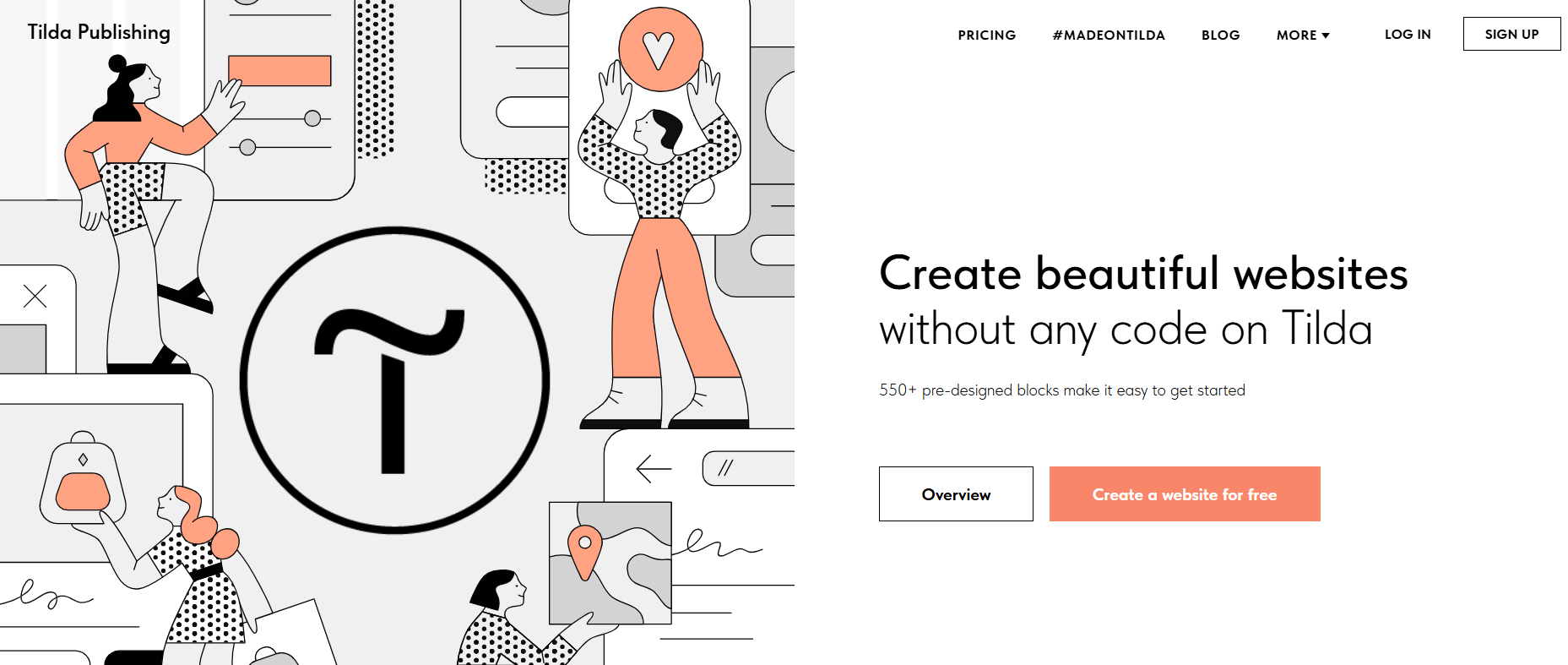
Now, let’s step into the world of Tilda Publishing. Imagine a pristine, modern design studio. Everything is meticulously organized, the tools are sleek and intuitive, and the aesthetic is inherently beautiful. This is Tilda. Developing on the Tilda website builder is a fluid, visual experience.
You work with pre-designed blocks and templates, like modular components in a prefab system. Drag, drop, customize content, and watch your website take shape with remarkable speed.
Tilda excels in its simplicity and focus on design. It’s designed for creators who want to produce visually stunning, content-rich websites – landing pages, portfolios, and sleek business sites – without diving into code.
The Tilda Publishing interface is incredibly user-friendly, making it a breeze for both seasoned designers and those less technically inclined. The “Zero Block” feature gives you a taste of deeper customization, allowing you to tweak block designs with precision, but the overall philosophy remains focused on streamlined, visual development.
Developing on Tilda is about efficiency and aesthetic impact. It’s perfect for agencies needing to rapidly prototype, create beautiful marketing campaigns, or build elegant websites where visual storytelling is paramount.
While the level of deep, backend customization is intentionally limited, Tilda empowers you to craft stunning online presences with remarkable speed and ease, freeing you to focus on design and content strategy.
WordPress vs Tilda: Key Criteria for Agencies and Developers
For agencies and developers, choosing a platform is a strategic business decision. It impacts workflow, client satisfaction, project scope, and long-term scalability. Let’s dissect the critical criteria to see where WordPress vs Tilda truly stand apart.
1. Customization & Flexibility: The LEGO vs. Clay Masterclass
In the battle of WordPress vs Tilda, let’s review the customizations and flexibility of both platforms.
Tilda: Picture yourself building with LEGOs. Tilda website builder hands you beautifully crafted, pre-designed blocks – think ready-made hero sections, slick galleries, and functional forms.
Snapping them together? Child’s play. Tweaking colors or text? A breeze through intuitive panels. But dare to dream beyond the LEGO instruction booklet? Want to build something wildly original, utterly bespoke? You’ll bump against the limitations of the blocks.
Customization in Tilda Publishing is like that – brilliant within its carefully curated system, but you’re always working within a pre-defined box of bricks. To develop, you’d typically select a block, use the right-hand settings panel to adjust preset parameters like colors, fonts, and images.

You do get access to pre-built themes that can be deployed instantly. For minor layout tweaks, sure — you can adjust columns or move blocks around. But when it comes to major structural changes? Things start to fall apart. Want to change how a block functions at its core? Good luck — you’ll hit a wall quickly.
Unlike WordPress, you don’t have the freedom to install your own plugins, write custom CSS, or extend functionality however you want. That’s the trade-off with platforms like Tilda Publishing — simplicity comes at the cost of control.
WordPress: WordPress hands you raw, incredibly versatile clay. Themes offer a starting form, but then you seize your sculpting tools – plugins, code editors, page builders. You mold, carve, and shape WordPress into anything your mind conjures.
To develop, you start by choosing a theme – think of it as your base armature. You can choose from a variety of themes and even upload your custom theme to WordPress.

Then, you layer on plugins to sculpt functionality, write custom CSS to refine aesthetics, and even dive into PHP for core alterations if needed.

You can build entirely custom post types, design unique database interactions, and craft features nobody’s ever seen before. Dream of interactive maps? Membership portals? E-learning platforms? WordPress is your limitless clay and toolset. Want a block to behave in a never-before-seen way? Code it, plugin it, make it happen.
Verdict: WordPress takes the crown for unleashing untamed creativity! When client visions soar beyond the ordinary, and agencies need to conjure the extraordinary, WordPress’s boundless customization is the superpower that transforms “impossible” into “let’s brainstorm the possibilities!”
17% Productivity BOOST?! Byborg Enterprises isn’t just working harder; they’re working smarter, thanks to InstaWP. (That’s like adding weeks to your year, again!)
2. Scalability & Extensibility: The Corner Store vs. the Global Marketplace
Let’s envision Tilda or WordPress for a small business website.
Tilda: With Tilda, you’re setting up a charming corner store. It’s perfect for showcasing a select product range, serving local customers, and maintaining a stylish, manageable operation.
Tilda shines for small projects and visually appealing landing pages — but it hits a wall when growth gets serious.
- While it offers a beautiful visual editor and some third-party integrations, you’re working within tight boundaries.
- You can’t install custom plugins, build complex databases, or deeply modify the CMS itself.
- There’s no real developer ecosystem, and advanced customizations require workarounds or compromises.
- Scaling beyond a few pages or basic content types? That’s when Tilda starts feeling more like a cage than a canvas.
It is better for personal projects, portfolios, or one-off marketing sites — not for businesses aiming to scale operations.
WordPress: WordPress is about building a global marketplace. It’s engineered to handle massive traffic surges, colossal product catalogs, and intricate user interactions – think eBay, think BBC News, think enterprise-level platforms. Development is about creating a robust infrastructure ready for any surge.
Need server capacity to weather a viral marketing storm? WordPress scales effortlessly. Need to seamlessly integrate a complex CRM or ERP system? WordPress extends without breaking a sweat. It’s the platform designed to evolve from a single market stall to a sprawling, international trade center, ready for any level of global commerce.
- You can start with a basic blog and grow into a massive eCommerce store, membership platform, LMS, or custom web app.
- With 60,000+ plugins and a global developer community, the platform is infinitely extendable.
- Want custom post types? Complex databases? API integrations? WordPress can handle it — and it won’t blink as you grow.
- With managed WordPress hosting that offers scalable infrastructure, achieving great level of scalability is a hassle-free job for agencies and developers.
Verdict: WordPress wins hands down for building future-proof empires, not just websites! Because agencies must equip clients with platforms that are not merely beautiful today, but can effortlessly withstand tomorrow’s tsunami of success (and user traffic!), WordPress is the long-term, scalable choice.
3. E-commerce Prowess: The Pop-Up Boutique vs. The 24/7 Retail Juggernaut
When it comes to building a successful online store, it’s not just about adding products and checkout buttons.
You need flexibility, performance, payment control, shipping integrations, marketing automation, and the ability to grow.
Here’s how WordPress and Tilda stack up:
Tilda: Tilda website builder offers Tilda CRM + Product Catalog, a native eCommerce module aimed at users who want to launch small stores without technical knowledge quickly.
Tilda for e-commerce is visually appealing and straightforward to set up – great for artists selling limited-edition prints, niche boutiques with unique items, or launching single, hero products. Development focuses on visual presentation and streamlined transactions for a smaller-scale operation. However, it’s not equipped for complex, high-volume, enterprise-level retail as:
- Only basic payment gateways (Stripe, PayPal, Yandex) are available. Third-party tools require Zapier or workarounds.
- You can’t extend the platform’s core functionality beyond what Tilda allows.
- CSS and JavaScript support are limited. Forget about modifying checkout logic or building advanced product filtering.
- Only suitable for simple catalogs. No native multi-warehouse, dynamic pricing, or third-party shipping integrations.
WordPress: WordPress, fueled by the e-commerce plugin powerhouse WooCommerce, is the digital equivalent of a 24/7 global retail juggernaut. You’ll have 1,000s of WooCommerce extensions for payments, shipping, taxes, memberships, subscriptions, etc.
The direct access to product hooks, REST API, custom post types, and deep backend logic makes e-commerce development a piece of cake with WordPress.
WordPress for e-commerce supports multi-vendor marketplaces, affiliate systems, CRM integrations, and ERP solutions.
Learn more about building an e-commerce store with WooCommerce here.
Verdict: WordPress triumphantly wins for powering e-commerce empires, not just side hustles! When clients are serious about online sales, agencies need to deliver platforms that are not just “good enough,” but relentlessly robust, endlessly scalable, and profoundly feature-rich. WordPress, with WooCommerce, delivers precisely that e-commerce dominance.
4. SEO Capabilities: The Business Card vs. The Search Engine Domination Strategy
A beautiful website is useless if no one can find it. That’s why SEO is non-negotiable when choosing a website platform — especially for businesses that rely on organic traffic.
So, who is the winner of WordPress vs.Tilda in terms of search engine optimization?
Tilda: When it comes to SEO, Tilda Publishing offers decent, built-in SEO tools – like providing you with a polished digital business card.
It covers essential SEO aspects – meta descriptions, mobile optimization, and clean URLs – ensuring your website isn’t completely invisible to search engines. Development involves filling in SEO fields within Tilda’s interface, ensuring basic on-page optimization.

However, SEO control is limited to these pre-set parameters. It helps you get listed, but it’s not designed for aggressive search engine domination.
There’s no way to extend or automate SEO optimizations. You’re limited to what Tilda offers. Only basic schema support is available, and adding custom structured data requires workaround coding or third-party scripts.
Dynamic URLs (like for blog posts or catalogs) are auto-generated with limited flexibility, which can affect crawlability and keyword targeting.
WordPress: WordPress, especially when armed with dedicated SEO plugins, becomes a true search engine magnet. Think of it as crafting a dynamic, constantly evolving SEO strategy, not just implementing basic settings.
Plugins like Yoast SEO and Rank Math empower you with granular, pixel-perfect control over every facet of on-page SEO, technical SEO (schema markup, site speed optimization), and content optimization tactics.
You can easily modify canonical URLs, header tags, and structured data at a granular level.
Verdict: If your website or your client’s business depends on organic search visibility, there’s no debate.
Tilda or WordPress? WordPress, because it gives you full SEO freedom, technical control, and scalable optimization.
Want a test site to compare SEO tools hands-on?
Spin up a WordPress staging site in seconds with InstaWP and experience the SEO flexibility yourself — no installs, no risk.
5. Design Freedom: The Coloring Book vs. The Painter’s Studio
Whether you’re building a portfolio, a landing page, or an enterprise-grade site, design freedom is critical. It determines how far you can push visuals, layout, animations, and interactivity — and whether your platform supports creativity or constrains it.
So, in the battle of WordPress vs. Tilda, who really gives you more design power?
Tilda: The first thing you should know about deciding between Tilda or WordPress for design flexibility is that Tilda gives you exquisitely drawn templates and design blocks – imagine them as pre-outlined coloring pages.
Tilda is built for simplicity and speed. It uses a block-based visual editor that’s incredibly easy to use — and beautifully designed out of the box.
Tilda offers 550+ ready-made blocks that cover most standard use cases — forms, headers, image galleries, pricing tables, etc.

For more advanced design, Tilda offers “Zero Block,” allowing custom positioning of elements, animations, and layering. All blocks are mobile-friendly and adjust automatically across screen sizes.

Tilda’s built-in fonts, spacing, and layout styles are minimal and modern — perfect for visual storytelling.
However…
- You can’t add custom elements or third-party design tools.
- You’re locked into the Tilda ecosystem. Want to radically change layouts or build from scratch? You’re limited.
- You can inject custom code, but full CSS/JS styling is restricted unless you upgrade to business plans.
WordPress: WordPress is your vast, fully equipped painter’s studio – a blank canvas overflowing with limitless artistic possibilities. Themes offer a starting palette – think of them as initial color washes – but then you, the artist-developer, have complete creative command.
Development involves choosing a theme as a foundation, then using CSS, HTML, and PHP to paint, sculpt, and layer your design vision onto the digital canvas.

Page builders like Elementor enhance visual design, offering drag-and-drop tools, but crucially, they never remove code-level access.
WordPress design is about unrestrained creative expression. It’s about transforming the wildest design fantasies into breathtaking digital realities, completely unconstrained by preset outlines.
Verdict: WordPress triumphs when it comes to Tilda Publishing vs WordPress for design freedom. When agencies are tasked with crafting websites that are not just visually appealing but conceptually revolutionary and aesthetically groundbreaking, WordPress delivers the blank canvas and the limitless toolkit needed to transform those audacious visions into breathtaking reality.
Launch a free WP test site and try your visual stack without touching the live site.
6. Content Management (CMS): The Digital Notepad vs. The Editorial Newsroom
When building a website, content isn’t just king — it’s the entire kingdom. Whether you’re running a blog, a product catalog, a course platform, or a media-rich site, your platform’s content management system (CMS) determines how well you can structure, scale, and control your content over time.
So, when it comes to Tilda or WordPress, which one gives you the tools to manage content like a pro?
When building a website, content isn’t just king — it’s the entire kingdom. Whether you’re running a blog, a product catalog, a course platform, or a media-rich site, your platform’s content management system (CMS) determines how well you can structure, scale, and control your content over time.
So, when it comes to Tilda or WordPress, which one gives you the tools to manage content like a pro?
Tilda: Tilda offers a clean, intuitive interface for content creation — ideal for short-form content, landing pages, and lightweight websites. Content is added visually via pre-designed blocks (text, images, forms, videos). Basic blog capabilities exist, but without the depth or flexibility of a true CMS.

Ideal for landing pages, minimalist blogs, or online portfolios where content remains relatively static, requiring infrequent updates and simple structures. Development emphasizes ease of content entry and visual presentation, but lacks the depth for complex content organization.
Its content management is easy, but not necessarily powerful, as:
- You’re limited to standard pages and catalog items. There’s no native support for content types like portfolios, FAQs, or testimonials.
- You can’t create categories or tags beyond simple groupings within the catalog or blog.
- You can’t build dynamic templates that automatically populate with content. Everything is more static.
WordPress: WordPress CMS transforms your website into a full-fledged editorial newsroom.
Engineered for intricate content structures and dynamic publishing workflows, it’s equipped to handle thousands upon thousands of articles, orchestrate multiple authors, manage complex editorial calendars, control granular user roles and permissions, schedule content releases with precision, and organize vast media libraries with ease.
Beyond posts and pages, you can create any content type (e.g., events, case studies, team members, products) with tailored fields and structures.
Development focuses on building robust content architectures using categories, tags, custom post types, and user role systems. Need to manage a multi-author online magazine, a rapidly updated news portal, or a sprawling, categorized knowledge base? WordPress CMS is in its element, providing unparalleled editorial command and control.
Verdict: In the battle of Tilda or WordPress, when it comes to content management, the winner is clear.
WordPress gives you an industrial-strength CMS that can adapt, scale, and power content for any business model.
If you’re a publisher, educator, marketer, or agency — and you care about organizing, optimizing, and scaling content —WordPress is the platform built for you.
Want to experiment with content types and taxonomies before launching? Try it in a staging sandbox for free — no installs, no mess.
7. Learning Curve & Development Speed: The Weekend Getaway vs. The Rewarding Expedition
In a world where timelines are tight and clients expect pixel-perfect results yesterday, ease of learning and speed of development are major decision-making factors when choosing a website platform.
So, how do Tilda and WordPress compare when it comes to how quickly you can learn and build?
Tilda: Tilda is designed for non-technical users, designers, and marketers who want to build beautiful websites quickly — without touching code. Hosting, SSL, and domains are handled inside the platform.
But, you have to work within its boundaries — you’re limited to pre-built blocks, have minimal control over advanced layouts, and customization options are constrained. If your project requires complex functionality, third-party integrations, or a custom user experience, you’ll quickly find that Tilda’s simplicity becomes its limitation.
Also, there’s no support for essential development tools like staging sites, sandboxes, or version control — making it less ideal for teams or agencies managing ongoing development workflows.
WordPress: WordPress is infinitely powerful — but with great power comes a steeper learning curve (especially if you’re self-hosting or developing custom functionality).
Beginners can start quickly with themes and block editors. To avoid messing up, they can also learn the development basics in WP test sites. While it’s true you have to handle hosting, domain setup, and potential migrations, today’s cloud-based development tools like InstaWP eliminate most of the heavy lifting.
With tools that spin up instant test environments, handle version control, and streamline plugin/theme testing, even WordPress’s complexity becomes manageable — making it a favorite among agencies that need both freedom and structure.
Verdict: While Tilda undeniably champions speed and ease for simple projects, WordPress rewards the investment in dedicated learning with vastly superior long-term development power, unmatched efficiency for complex projects in the long run, and the acquisition of a highly sought-after, future-proof skill set that translates to greater agency profitability and client satisfaction.
8. Hosting & Maintenance: The White-Glove Concierge vs. The Customizable Infrastructure Mastery
When choosing a website platform, what happens after launch matters just as much as the build. Hosting reliability, maintenance flexibility, and ease of updates all impact your site’s performance, security, and scalability.
So, how do Tilda and WordPress stack up when it comes to hosting and ongoing site management?
Tilda: Tilda includes hosting, SSL, and domain connection out of the box — no third-party setup required. Tilda handles everything under the hood — but you also can’t control or customize what happens there.

Tilda handles server management, performance optimization, and updates. You never have to worry about the hosting configuration. But you’re on your own to manage sites, as there are no centralized workflows for this.
WordPress: WordPress gives you hosting flexibility — whether you want to control every detail or rely on a managed hosting provider. You’ll have full control over files, database, caching, and server configurations.
Managing sites is also a piece of cake with site management tools that bring everything, from bulk updates to site speed scans.
97+ PageSpeed Scores on 14 Sites?! Happyplankton did it with InstaWP hosting. (Yeah, fourteen blazing-fast sites!)
This level of granular control is absolutely crucial for performance-critical websites, security-sensitive applications, or agencies seeking to offer premium, fully managed hosting services to their clientele.
Verdict: If you want a no-fuss, “done-for-you” setup and have minimal growth needs, Tilda is a neat package.
But if you’re an agency, developer, or serious business planning to grow, customize, and own your infrastructure, WordPress wins — especially when paired with modern cloud tools like InstaWP.
9. Pricing & Cost-Effectiveness: The All-Inclusive Vacation vs. The Strategic Investment Portfolio
When building a website, the real question isn’t just “How much will this cost me today?” — it’s “How much value will I get for what I spend?”
Let’s break down the cost structure and pricing flexibility of Tilda vs. WordPress — and see which platform truly gives you more bang for your buck.
Tilda: Tilda offers tiered, all-in-one pricing — making it attractive for beginners and solopreneurs who want clarity and simplicity. Limited features, Tilda branding, and no custom domain.
Pricing is transparent, and upfront costs are easily calculated, making Tilda initially appealing for smaller projects or budget-conscious clients who value predictable monthly expenses.
WordPress: WordPress is open-source, meaning the software itself is free, but the cost depends on how you build and host it. Development costs primarily arise from independently securing website hosting, registering a domain name, and optionally investing in premium themes and plugins to enhance design and functionality.
While initial project costs may appear more variable compared to Tilda Publishing’s all-inclusive subscriptions, WordPress offers demonstrably superior long-term cost-effectiveness, especially as agencies scale their operations and strategically leverage open-source resources and cost-optimized hosting solutions.
Agencies gain granular control over their spending, avoid perpetually recurring platform subscription fees, and can build equity in their own development infrastructure and reusable code assets.
Verdict: Tilda gives you a predictable monthly cost with limited functionality — perfect for static websites or one-off landing pages.
WordPress offers a modular, scalable cost structure that grows with your site. Whether you’re bootstrapping or building a 100-site agency operation, you choose where to invest. You can also opt for affordable managed WordPress hosting options that give you scalable server infrastructures and built-in development.
Building Your Agency’s Future – Brick by Powerful Brick
Choosing between WordPress vs Tilda for your agency isn’t about finding a single “best” platform. Both are powerful tools, each with unique strengths. Tilda shines brilliantly for rapid, visually driven projects, especially where speed and aesthetic simplicity are paramount.
However, for agencies building robust, scalable, and truly bespoke online experiences for clients, WordPress remains the undeniable champion. It’s the artisan workshop offering limitless potential.
WordPress empowers you to craft websites that are not just visually appealing but also functionally rich, incredibly customizable, and built for long-term growth. Its unmatched flexibility, scalability, SEO prowess, e-commerce capabilities, and vast ecosystem make it the platform of choice for agencies committed to delivering comprehensive, future-proof solutions.