The best LocalWP alternative depends on why you are leaving Local. If you want sites that live online, so clients can review them, teammates can share them and the build can go live without a migration, InstaWP is the strongest pick: it is the AI-native WordPress cloud with managed hosting and instant sandbox sites, plus a CLI that still runs WordPress on your own computer.
If you only want another free desktop app, WordPress Studio or DevKinsta are closer swaps, and DDEV or wp-env suit Docker users. Below we cover why developers move off LocalWP, why InstaWP leads for agencies, and how eight alternatives compare, with versions checked on 6 November 2026.
- LocalWP 10.2.0 is free, but it is a 384 MB to 855 MB download that needs 4 GB of RAM, and every site lives on one computer.
- The most common reasons to switch: Live Links that only work while your computer is on, manual Cloud Backups, and Local Connect pushing only to WP Engine or Flywheel.
- InstaWP is the best LocalWP alternative for teams and agencies: a Sandbox site is $2 a month, it has a public URL from the start, and it goes live on the same URL with no migration.
- InstaWP does not force you off your laptop: its CLI starts a local WordPress site in about 11 seconds, and Local Mount opens a cloud site in VS Code.
- For a free desktop replacement, pick WordPress Studio (2.1.1) or DevKinsta; for Docker workflows, DDEV (1.25.5) or wp-env (12.1.0).
Table of Contents
What is LocalWP?
LocalWP (Local by WP Engine) is a free desktop app that turns your computer into a WordPress development server, so you can build a site with no hosting and no internet connection. Developers use it to create a WordPress development environment or a WordPress sandbox: a clean install or a copy of a live site where changes cannot break anything.

It runs on macOS, Windows and Debian-based Linux. You install the app, create a site, and Local sets up the web server, PHP and database for you. You open the site on a local URL, build it, and later export it to a live host.
Version 10.2.0 (15 October 2026) bundles PHP 8.2.29, nginx 1.26.1, MySQL 8.4.0 and MariaDB 10.11.18, and downloads other PHP versions on demand. The installer is 384 MB on Linux and 855 MB on Windows, and the Linux package takes 1.4 GB once installed.
Is LocalWP free?
Yes, LocalWP is free, and it has been since 2021, when the team dropped the paid Local Pro tier and made every feature available to everyone. They even refunded people who were paying for a subscription.

Two things are worth knowing: you need a free Local account for Live Links and Cloud Backups, and Cloud Backups store your files in your own Google Drive or Dropbox. The real cost of LocalWP is not money but the limits of working on one machine, covered below.
Why do developers like LocalWP?
Developers like LocalWP because it is free, quick to learn and works offline. It also handles PHP version switching and one-click admin login, which saves time on every project. Here is what it does well.
It’s easy to use
Whether you are an experienced developer or trying WordPress for the first time, LocalWP’s three-step site wizard (name, environment, admin user) gets you a working site with no server knowledge.
You don’t need the internet to use it
LocalWP runs everything on your computer, so you can keep working on a plane, in a place with poor connectivity, or when you want to stay off the internet to focus.
You can test sites in an isolated environment
Each Local site is separate from your live site, and Local can clone a site with one click. With Local Connect you can also pull a site down from WP Engine or Flywheel and test changes on the copy.
LocalWP ensures cross-compatibility with flexible PHP environments
You can switch a site’s PHP version and test your theme or plugin against it before you ship, which catches version conflicts early.
LocalWP has plenty of valuable features
The team behind LocalWP added features that make local development easier:
- Flexible environments: choose the PHP version, web server and database for each site.
- Live Links: share a URL such as mysite.localsite.io with clients and teammates while your computer is on.
- One-click admin: log in to WordPress without remembering usernames or passwords.
- Cloud Backups: back up a site to Dropbox or Google Drive when you click Back up, and restore it on another computer.
- Local Connect: push and pull sites to and from Flywheel or WP Engine.
It is a good tool, but it is not flawless, and its drawbacks are why developers look for the best LocalWP alternatives.
Why do developers look for a LocalWP alternative?
Developers look for a LocalWP alternative when their work outgrows one computer: when clients need to review sites, teammates need to share them, or the site has to go live on a host other than WP Engine or Flywheel. These are the drawbacks that come up most.
You are device-reliant
Your sites live on the computer where Local is installed. On a new machine you install a 384 MB to 855 MB app again and restore your sites. Local needs at least 4 GB of RAM and 1.5 GB of disk, so an older laptop can struggle, and if the machine crashes without a recent backup, the work is gone.
Backups are not automatic
Cloud Backups only run when you click Back up. Local’s backups are incremental, so they are quick, but if you forget and something happens to your computer, you redo the work from your last backup.
Live links have limitations
Live Links are view-only, need a Local account, and tunnel to your computer, so a client can see the site only while your machine and Local are running. If a teammate needs to continue your work, you still back up the site and have them restore it on their own machine.
LocalWP is not a natural fit for remote teams. Live Links can also load slowly, which does not make a good impression when you present work to a client.
Other apps can come into conflict with LocalWP
Local runs its own web server and database services, so antivirus software, firewalls and other development tools can block them. Users on the Kaspersky forum have reported Kaspersky throttling Local, and on Windows you approve a series of firewall prompts during setup.
Migrating the site can only be done with Flywheel or WP Engine
Local Connect deploys only to Flywheel and WP Engine, which makes sense because WP Engine owns Local. If your client already hosts somewhere else, you export the site and migrate it with a plugin or by hand. That works, but it is one more step where things can break.
Developing locally is not the same as developing online
Your computer is not the server the site will run on. Different PHP settings, caching, file permissions and resources mean something that works locally can fail after launch.
Together these limits slow agencies down: collaboration, migration and backups all need extra tools. A better setup gives you:
- Sites in seconds: no local install and no environment problems.
- Backups and migrations built in: no extra plugins or manual exports.
- Real collaboration: everyone works on the same site, so “it works on my machine” goes away.
- One-click staging: test changes on a copy without manual cloning.
- Remote management: manage and deploy from anywhere.
That is the case for a cloud-based LocalWP alternative, and it is what InstaWP is built for.
Why is InstaWP the best LocalWP alternative for agencies?
InstaWP is the best LocalWP alternative for agencies and teams because it keeps the speed of local development but runs every site online. Sites take seconds to create, clients preview them on a real URL, teams work on the same site, and the build becomes the live site on InstaWP’s managed cloud hosting with no separate host and no migration.
All of that sits under one roof in InstaWP, so you replace a local app, a backup add-on, a sharing tunnel and a migration plugin with one account.

You also do not have to give up local development entirely. Some work still suits your own machine:
- Working offline: when your connection is limited or unreliable.
- Deep debugging: direct access to logs and the database.
- Rapid prototyping: testing ideas with no network delay.
- Learning: a safe, isolated place to experiment.
- Many projects at once: sites with different PHP versions side by side.
InstaWP covers those cases two ways. Its Local Mount feature opens a cloud site as a folder on your computer, so you edit in your own tools while the site runs in the cloud. And its CLI creates real local WordPress sites, covered below.
What makes InstaWP one of the best LocalWP alternatives?
Building on InstaWP instead of LocalWP gives you these advantages:
InstaWP can be accessed on any internet-ready device
When you create your staging environment on InstaWP, you are not tied to one computer. Any device with a browser can open the site. Because the site runs on a real server, what you test is close to what will go live.
Test websites are easily shared
Sharing an InstaWP site with your team or client is simple. In your InstaWP dashboard, click the three dots next to the site name, then View Creds.

The site’s URL, username and password appear, ready to share with anyone.

Your team can then work on the same site without needing your computer.
You don’t have to worry about storage or backups
Sites use InstaWP’s storage, not your disk, and every plan takes automatic backups: monthly on Sandbox, weekly on Starter and daily (kept for 30 days) from Plus. There is no add-on to connect and nothing to remember.
Your work doesn’t disappear on a timer, either. Every InstaWP site now runs on a plan billed daily (from $2 a month for a Sandbox), so it stays live until you delete it. The two screenshots below date from 2023, when free disposable sites expired and had to be restored or reserved:

Reserving a site is no longer needed, because a site on any plan stays until you delete it.

You have more options in terms of migrating your site
LocalWP only deploys to Flywheel or WP Engine. InstaWP includes free migrations to and from other hosts, and its dashboard can connect hosting accounts such as:
- RunCloud
- Cloudways
- Pressable
- ServerAvatar
So a hosting subscription you already pay for is not wasted. Or you host the site directly on InstaWP, one of the best managed WordPress hosting solutions for agencies.
InstaWP’s own managed WordPress hosting gives each site:
- Its own isolated environment with a reserved vCPU, so a busy neighbor cannot slow your site.
- InstaCDN and the InstaShield firewall, basic on Starter and premium or advanced from Plus.
- Automatic backups, daily from Plus.
- Go-live on the same URL: move a Sandbox site to a production plan with no migration.
- Managed updates and uptime monitoring from Plus.
With InstaWP hosting, hosting is not a separate vendor you migrate to at the end. It is the same site you built, on the same dashboard.
You can still run sites on your own computer
The InstaWP CLI (beta) runs real WordPress sites locally on WordPress Playground, with no Docker and no desktop app. On 6 November 2026, npm install -g @instawp/cli took 4.7 seconds (53 MB), and instawp local create had a site running in 19.1 seconds the first time and 11.1 seconds after that, using about 16 MB per site. When the site is ready, instawp local push sends it to the cloud.
Already have sites in LocalWP? instawp migrate push copies a Local site’s files and database to a new InstaWP site from localhost, with no tunnel. Our LocalWP migration guide walks through it.
How do you switch from LocalWP to InstaWP?
Switching takes four steps: create an InstaWP site, open it, bring over your Local sites, and connect your editor. Creating an account is free; you add a card to launch a site, which unlocks $25 in credits.
1. Create a site
In the dashboard, click Add Site, choose From Scratch, a template or a snapshot, and pick the WordPress version, PHP version and server location. Choose the Sandbox plan ($2 a month) for development.

2. Open the site with Magic Login
The site is ready in seconds, with its URL and credentials on screen. Magic Login opens WordPress admin with no password, and the URL is already shareable.

3. Bring over your LocalWP sites
Install the CLI, log in, and run instawp migrate push on each Local site’s folder (add --dry-run first to preview). The new site lands on the Sandbox plan. See the push docs for every option.

4. Connect your editor with Local Mount
In the site menu, open Developer Tools, then Local Mount, and toggle on Enable Mount. Connect from Finder, File Explorer or your Linux file manager with the server address, username and password shown, following the Local Mount docs.

What are the other LocalWP alternatives?
If you want to keep working on your own computer, the closest LocalWP alternatives are WordPress Studio and DevKinsta (free desktop apps), DDEV and wp-env (Docker-based command-line tools), and the WordPress Playground CLI (no Docker at all). XAMPP and MAMP remain options for learning the raw stack. We checked each tool’s current version on 6 November 2026.
How to choose:
- Want a drop-in free desktop app? WordPress Studio or DevKinsta.
- Want the environment defined in a file your team commits? DDEV or wp-env.
- Want WordPress in seconds with nothing but Node.js? The Playground CLI, or the InstaWP CLI if you also want to push the site to hosting.
- Want clients and teammates on the same site, and the build to become the live site? InstaWP.
For tool-by-tool guides, see our XAMPP alternatives, MAMP alternatives and WordPress Playground guide. For Flywheel’s hosting side as well as Local, read Flywheel alternatives.
LocalWP vs. InstaWP: feature comparison
LocalWP is built for local development on your own computer, and InstaWP for cloud development, collaboration and hosting. Here is how they differ feature by feature. For the full head-to-head, with setup measurements and walkthroughs, read LocalWP vs InstaWP.
WordPress development environment
LocalWP: sites live on your computer’s drive. Best for offline and resource-heavy work.
InstaWP: sites run on InstaWP’s servers and open from any device, which makes team work easy.
Accessibility
LocalWP: works offline. A Local account is only needed for Live Links and Cloud Backups.
InstaWP: needs an internet connection (or the CLI for local sites). Account creation is free; a card is needed to launch sites.
Speed and performance
LocalWP: page loads are fast because there is no network, but the app is a 384 MB to 855 MB install.
InstaWP: nothing to install for cloud sites, and new sites are ready in seconds. Page speed depends on your connection.
Storage
LocalWP: limited by your computer’s disk. Large media libraries stay local.
InstaWP: storage comes with the site’s plan (5 GB on Sandbox, 10 GB on Starter), which frees up your own disk.
Site creation and cloning
LocalWP: create sites from scratch or from a saved blueprint, and clone existing sites.
InstaWP: create from scratch, a template, a snapshot or a copy of a live site, and clone in one click.
Deployment and migration
LocalWP: Local Connect pushes to WP Engine or Flywheel; backups go to Google Drive or Dropbox.
InstaWP: push and pull between staging and live, and migrate across hosting providers, or go live on InstaWP on the same URL.
Collaboration and sharing
LocalWP: Live Links for view-only previews while your computer is on.
InstaWP: Git integration, shared credentials and Magic Login for the whole team.
Features and tools
LocalWP: one-click admin, WP-CLI, SSH and Mailpit, all free.
InstaWP: Magic Login, SSH, SFTP, WP-CLI, Git, templates, the InstaWP Connect plugin and Local Mount on every plan. Hosting features such as CDN, firewall and object cache depend on the plan.
Staging and testing
LocalWP: isolated local copies for safe testing.
InstaWP: cloud-based staging for testing on the same kind of server the live site uses.
Support
LocalWP: community forums and help docs.
InstaWP: human support on every plan.
This InstaWP vs. LocalWP table sums it up:
And InstaWP goes beyond development, migration and hosting. It also helps you manage sites after launch.
For agencies with many WordPress projects, InstaWP has a central site management dashboard, something LocalWP does not offer:
- One dashboard: every site, InstaWP-hosted or connected with the InstaWP Connect plugin, in one list.
- Magic Login: open any site’s admin without hunting for credentials.
- Managed updates: plugin, theme and core updates handled for you from the Plus plan.
- Uptime monitoring and activity logs: see when a site goes down and who changed what.
- Vulnerability, performance and malware scanners: catch problems before a client does.
- Client reports: send a PDF report of the work you did.
With InstaWP as a LocalWP alternative, agencies build, host, manage and scale from one platform.
Can you host your site on InstaWP after leaving LocalWP?
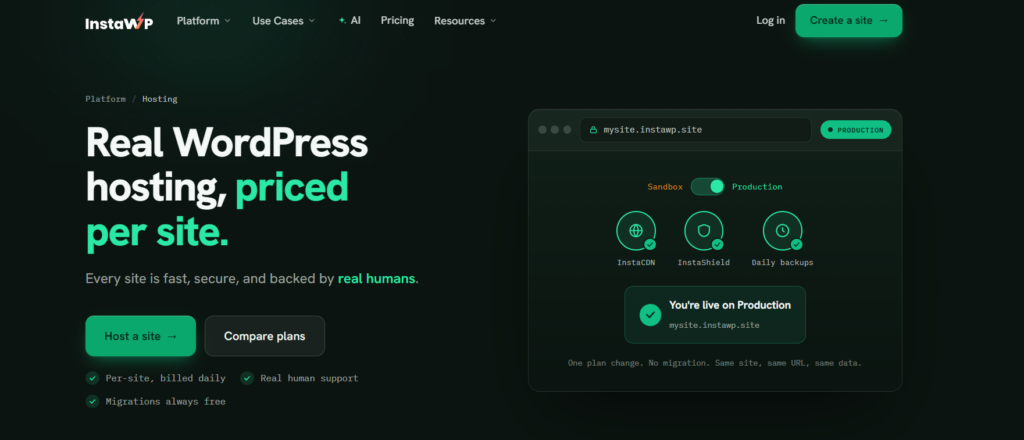
Yes, and that is the biggest difference from LocalWP. InstaWP is a managed WordPress hosting provider, so a site you build on Sandbox moves to a production plan on the same URL, with its data intact and no migration.
Prices from instawp.com/pricing on 6 November 2026, billed per site per day, with a 14-day money-back guarantee. In InstaWP’s August 2026 hosting benchmark, a site on the new-generation servers scored 9.8 out of 10 in the WP Benchmark plugin.
Conclusion
LocalWP still has a place for offline, solo test sites, and it is free. But modern WordPress work usually involves clients, teammates and a launch, and that is where a local-only tool runs out. If you want speed, flexibility and a workflow that carries a site from first draft to live, InstaWP is the LocalWP alternative to pick. With Local Mount and the CLI, you keep your local tools too.
Teams and agencies: InstaWP, for shared sites, automatic backups and go-live without migration. Solo developers who want a free desktop app: WordPress Studio or DevKinsta. Docker users: DDEV or wp-env.
With InstaWP you stop draining your computer’s resources, get automatic backups, test in an environment that mirrors the live server, and move from development to production on one platform.
Sign up today and build your next WordPress site the faster way.
Frequently asked questions
What is the best LocalWP alternative?
For teams and agencies, InstaWP: it runs every site online with a public URL, takes automatic backups, and turns the build into the live site with no migration, from $2 a month per site. For a free desktop app like Local, choose WordPress Studio or DevKinsta; for Docker workflows, DDEV or wp-env.
Is there a free alternative to LocalWP?
Yes. WordPress Studio, DevKinsta, DDEV, wp-env, the WordPress Playground CLI and XAMPP are all free. InstaWP is not free: a Sandbox site costs $2 a month, and adding a card gives you $25 in credits to start.
Is LocalWP still free in 2026?
Yes. Local 10.2.0, released 15 October 2026, is free. A Local account is only needed for Live Links and Cloud Backups.
Can I move my LocalWP sites to InstaWP?
Yes. Run instawp migrate push from the InstaWP CLI on the Local site’s folder. It copies the files and database to a new hosted InstaWP site, working from localhost with no tunnel. The new site starts on the Sandbox plan.
Does InstaWP work offline like LocalWP?
Cloud sites need an internet connection. For offline work, the InstaWP CLI runs WordPress sites on your own computer with WordPress Playground, and you push them to the cloud when you are back online.
Can I host my site on InstaWP after building it?
Yes. InstaWP is a managed WordPress hosting provider. Switch the site from Sandbox to a production plan such as Starter ($5 a month) or Plus ($9 a month) and it goes live on the same URL, with backups, CDN and a firewall depending on the plan.
Is WordPress Studio the same as InstaWP Studio?
No. WordPress Studio is Automattic’s free desktop app for local WordPress development. InstaWP Studio is InstaWP’s AI website builder (beta) that turns a business description into a hosted WordPress site.


