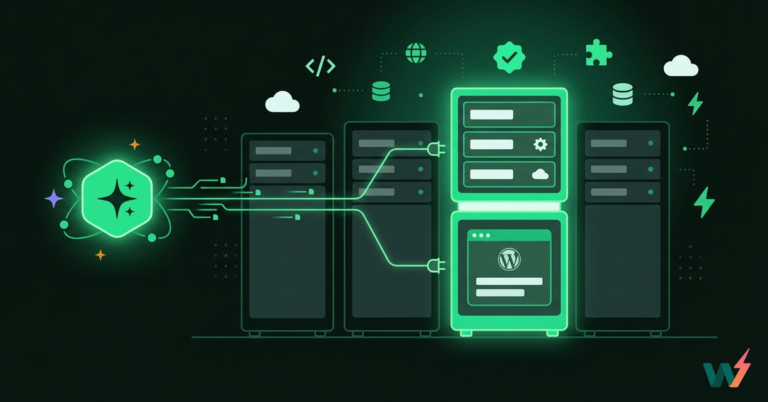
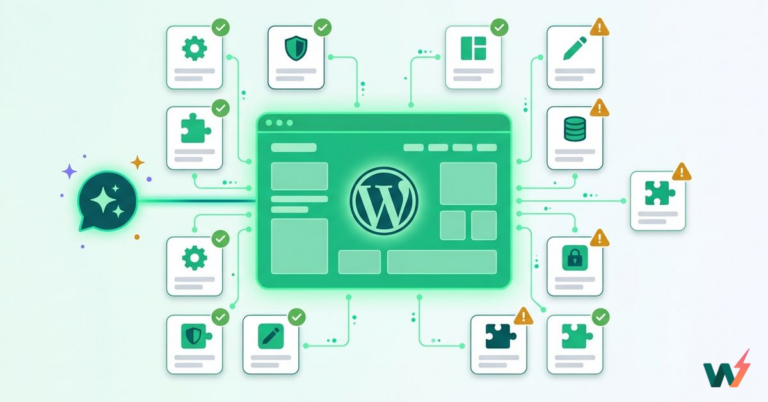
WordPress MCP is the Model Context Protocol applied to WordPress: a typed, permissioned set of tools that an AI client such as Claude, ChatGPT or Cursor can call on your site, so a plain-English instruction becomes a real action instead of a suggestion you still have to perform yourself. WordPress does not ship an MCP server in core. It ships the Abilities API, and a separate layer turns those abilities into MCP tools.
Four different things now answer to the name “WordPress MCP server” and only three of them can reach a site you own: the official MCP Adapter, a self-hosted community server, and hosted MCP built into your platform, such as InstaMCP. The fourth belongs to WordPress.org and exists to submit plugins to the plugin directory.
Choosing between the three turns on one question: whether the AI needs to read your site or change it. Most hosted MCP in 2026 is read-only, so a server that answers questions about a site perfectly well will refuse to publish a post or update a plugin. Our side-by-side of the best WordPress MCP servers covers the full field.
Key takeaways
- Four different things are called a “WordPress MCP server”. The WordPress.org server only submits plugins to the directory. The MCP Adapter, a hosted host-level server and a self-hosted server are the three that actually control your site.
- MCP is a protocol, not a plugin. It standardises how an AI client discovers and calls tools on an external system.
- WordPress got a native path in 6.9. The Abilities API landed in core, and the separate
WordPress/mcp-adapterplugin exposes those abilities over MCP. It is on v0.6.1 and still pre-1.0. - The old Automattic plugin is gone.
Automattic/wordpress-mcpwas archived on 19 January 2026. Anything still pointing you there is out of date. - Most hosted MCP is read-only. Pressable and WP Engine both ship MCP that reads your site but will not write to it. InstaMCP is the write-capable one: one toggle, 43 typed tools, 13 supported AI clients, no plugin install and no application passwords.
- There are two layers. Site MCP works inside one site. Account MCP works across your whole account, which is what makes 40 client sites manageable.
- Permissions are the real story. Every action runs through a typed tool, scopes ride on the token, and the three powerful tools are off by default.
Table of Contents
What is a WordPress MCP server?
An MCP server is a program that exposes the capabilities of a system as a structured list of tools an AI model can call. Model Context Protocol is an open standard originally published by Anthropic and since adopted across the major AI vendors.
The problem it solves is boring but real. Language models are good at deciding what should happen and bad at reliably performing it. Before MCP, every AI product wrote its own bespoke integration for every service. MCP replaces that with one contract: the server publishes what it can do, the client discovers it, and the model picks a tool and fills in the arguments.
Three pieces make up any MCP setup:
- MCP client. The AI application you actually talk to. Claude Desktop, Claude Code, ChatGPT, Cursor, Windsurf, VS Code with Copilot and others.
- MCP server. The program that sits in front of the system being controlled and publishes its tools.
- Transport. The connection between them, either a local process on your machine or a remote HTTP endpoint.
The important detail is that a tool is typed. It has a name, a description and a schema of allowed arguments. A model cannot invent a new capability, and it cannot smuggle an arbitrary command through a tool that only accepts a post ID and a title. That constraint is what makes it safe enough to point at a production system.
In plain terms
An API is how software talks to software. MCP is how AI talks to software.
A REST API assumes a developer read the documentation and wrote the call. MCP assumes a model is reading the tool list at runtime and choosing for itself, so the description and the schema have to carry the meaning.
Now, if we talk about WordPress MCP server, it is an MCP server that exposes WordPress operations as tools. Once connected, an AI client can read and write posts and pages, manage taxonomies and media, inspect plugins and themes, edit metadata and run diagnostics, all from natural language, without anyone opening wp-admin.
In practice that means instructions like these do real work:
- “List every draft post on the client site and tell me which ones have no featured image.”
- “Create a new post titled Holiday Campaign Ideas, set the category to Marketing, and leave it as a draft.”
- “Which plugins on this site have updates available?”
- “Update the SEO title and meta description on these four posts.”
- “Show me the comments awaiting moderation.”
How a WordPress MCP request actually works
- You type an instruction into your AI client.
- The client reads the tool list published by the WordPress MCP server and selects the tool that matches, for example a content listing tool.
- The model fills in the arguments defined by that tool schema, such as post type, status and count.
- Most clients pause here and ask you to approve the call. You see exactly which tool is about to run.
- The server checks the token scope, executes against WordPress (usually through the WordPress REST API or a direct internal call), and returns structured data.
- The model reads the result and either answers you or chains into the next tool.
That approval step in the middle is worth noticing. MCP does not run unsupervised by default. The model picks a tool and you approve it, and the schema limits what that tool could do even if you approve the wrong one.
The 2026 change worth knowing
WordPress 6.9 added the Abilities API to core.
Before this, every WordPress MCP server invented its own vocabulary for what a site can do. The Abilities API gives WordPress a standard, typed way to declare capabilities that plugins and themes can register into, and MCP is the layer that exposes them to AI clients. The core team set it out in the Abilities API in WordPress 6.9, and core has kept building on that foundation since, as our rundown of WordPress 7.0 features covers.
Does WordPress have an official MCP server?
Yes and no, and the difference decides what you end up installing. WordPress core does not contain an MCP server. Core ships the Abilities API, which is the standard way a plugin or theme declares what it can do. The official bridge from those abilities to MCP is a separate plugin, WordPress/mcp-adapter, maintained under the WordPress GitHub organisation. Separately, WordPress.org runs its own MCP server, and it has nothing to do with your site.
Four things currently answer to the name “WordPress MCP server”. Here is what each one actually controls, and where it lives.
So if the question is “does WordPress have an MCP server for my site”, the answer is that core supplies the abilities and something else has to expose them over MCP.
The three ways to run WordPress MCP in 2026
Three approaches expose a WordPress site over MCP, and they suit very different teams. What separates them is who runs the server, how it authenticates, and how many sites one connection covers.
| Comparison | Official Abilities API + MCP Adapter Core-native WordPress approach | Self-hosted Community Server Build and maintain it yourself | Hosted InstaMCP Managed MCP for WordPress |
|---|---|---|---|
| Setup | Install a plugin, requires WordPress 6.9+ | npm or Composer install, config file, and a running process | One dashboard toggle |
| Authentication | Application passwords | Application passwords stored in a config file | Connection URL with an embedded token |
| Who maintains it | WordPress project | Your team | InstaWP |
| Tool surface | Whatever abilities are registered on the site | Whatever the project has implemented | 43 typed tools |
| Multi-site handling | One connection per site | One config file can list multiple sites | Per-site connection or one account-level connection |
| Best for | Developers on WordPress 6.9+ who want the core-native path | Teams with custom stacks and their own DevOps | Agencies and teams that want MCP working without infrastructure setup |
Official Abilities API + MCP Adapter
Self-hosted Community Server
InstaMCP
1. The official path: Abilities API and the MCP Adapter
This is the route the WordPress project itself is building. The Abilities API shipped in WordPress 6.9. The bridge to MCP is a separate plugin, WordPress/mcp-adapter, which is currently on its own release cadence. The WordPress developer blog published the introduction to the adapter in February 2026. The current release is v0.6.1, published 13 August 2026, and it is still pre-1.0: the public API has changed between minor versions, with migration guides for v0.3.0 and v0.5.0. It is also not listed in the WordPress.org plugin directory, so searching Plugins, Add New for “MCP Adapter” finds nothing and there is no one-click update path. Install it with Composer or from a GitHub release.
Important correction
The old Automattic plugin is archived.
Automattic/wordpress-mcp was archived on 19 January 2026 once the Abilities API landed in core. If a tutorial tells you to install it, that tutorial predates the change. Migrate to the MCP Adapter. We reviewed it in detail in our WordPress MCP Adapter review.
is_user_logged_in(), which means any authenticated account, including a Subscriber, can reach a server created without an explicit callback. If your own permission callback throws, the adapter logs the failure and falls back to that same default rather than failing closed. Our WordPress MCP Adapter review walks through this, the missing SSE transport, and the rest of the setup in depth.2. Self-hosted community servers
Several independent MCP servers for WordPress exist, including our own open-source implementation at InstaWP/mcp-wp. These run as a process on your machine or a VM, hold a config file listing your sites, and authenticate with application passwords.
They are genuinely useful if you want full control of the middleware, and they were the only real option before 6.9. The trade-off is that you own the process, the credentials file and the updates. If you are choosing between approaches, our comparison of InstaWP MCP vs WordPress MCP goes deeper.
A newer variant packs the MCP server into a WordPress plugin instead of a separate process. Novamira is the most capable example: a free, open-source WordPress MCP plugin that runs on any host and gives an agent PHP, WP-CLI and file access. The trade-off is control, because every Novamira ability needs an administrator and there is no read-only mode. Our Novamira review tests it head to head with InstaMCP.
3. Hosted MCP built into the platform
The third option is to let your host run it. The platform installs the server-side piece, issues the credential and keeps both updated, so you do not install a plugin, write a config file or keep an application password on your laptop. You flip a toggle and paste a URL.
The trade-off is that you get the tool surface your host decided to build, and you get it only on sites you host there. It is also the route where providers differ most, because two hosts can both say they support MCP and mean opposite things by it.
What hosted WordPress MCP gives you, host by host
“Our host supports MCP” covers two very different products. Some hosts ship a read-only bridge so an AI can describe your site. Others let the AI change it. If you are evaluating hosts on MCP, this is the line to check first, because a read-only server cannot run any of the agency workflows further down this page.
InstaMCP: WordPress MCP built into your host
InstaMCP is the MCP server built into InstaWP managed WordPress hosting. Turning it on installs the plugin, generates a scoped token and gives you a connection URL. It is available on a Sandbox plan and above.
What you get once it is on:
The two most underrated tools
Skills and Memory.
Most MCP servers stop at “the AI can edit a post”. Skills let you store a playbook the model follows every time, for example how your agency structures a service page. Memory stores durable facts about that specific site, such as the client brand voice or which plugin handles forms. Together they are the difference between an AI that can technically write and an AI that writes the way you do.
Which AI clients can connect
InstaMCP 1.1 supports 13 AI clients: Claude Desktop, Claude Code, Claude.ai, Cursor, Windsurf, Cline, Roo Code, GitHub Copilot, Zed, Gemini CLI, OpenAI Codex CLI, ChatGPT and Continue.dev. Read the InstaMCP 1.1 release notes for what changed.
Try WordPress MCP without setting anything up
Spin up a free WordPress sandbox, flip on MCP, and connect Claude or ChatGPT in about two minutes.
Create a free WordPress sandboxHow to set up WordPress MCP on InstaWP
You need an InstaWP account with a site on a Sandbox plan or above, and an AI client that supports MCP. You do not need Node.js, a config file or an application password. If you have not created a site yet, follow the docs on how to create a WordPress site, or spin up a disposable WordPress sandbox to test on.
Step 1: Enable MCP on the site
Open your InstaWP dashboard, go to the site you want to connect, and find the MCP menu in the left sidebar of the site detail page.

Switch on the Enable MCP toggle.

That single toggle installs the InstaMCP plugin on the site for you. You can confirm it under Plugins in wp-admin, though there is nothing you need to configure there.

Step 2: Copy your connection URL
With MCP enabled, the page shows a connection URL for that site.

Treat this URL as a credential
The authentication token is embedded in the URL.
Anyone holding it can reach the site at the scope you granted. Do not paste it into a support ticket, a shared document or a Slack channel. If it leaks, disable and re-enable MCP to rotate it.
Step 3: Connect your AI client
In Claude Desktop, open Settings and go to the Connectors tab.

Choose Add custom connector, paste the connection URL, and give it a name you will recognise later. If you manage several client sites, name them properly now. “Client Site, Acme Corp” is much easier to live with than “WordPress 3”.

Once it is added, click Configure to see every tool the connector exposes.
Watch how to connect WordPress with Claude using WordPress MCP server of InstaWP.
Step 4: Run your first commands
Start with something read-only so you can watch the approval flow before anything changes. Try “List all posts on the WP site”.

Claude asks permission before running the tool, and tells you which tool it wants to use. Approve it and you get structured results back. From there you can move on to writes:
- “Create a draft post about AI trends in WordPress and set the category to News.”
- “Which plugins on this site need updating?”
- “Read the site logs and tell me what caused the last fatal error.”
- “Show me all pending comments and flag anything that looks like spam.”
Connecting ChatGPT instead
The same connection URL works with ChatGPT. Open ChatGPT, go to Settings, then Apps and Connectors, and add a new connector.

Paste the URL, name it, and set authentication to “No authentication” because the token is already carried in the URL. Confirm and create. You now have the same tool surface from ChatGPT.
For a walkthrough of connecting other clients, see our guide on how to connect AI agents to WordPress using MCP.
Account MCP vs Site MCP
This is the part almost no WordPress MCP guide explains, and it is the part that decides whether MCP is workable at agency scale.
Site MCP, which is what we set up above, works inside one WordPress site. Account MCP works outside the sites, across your whole InstaWP account. Think of it as a building manager and an interior designer. The building manager creates units, takes snapshots and upgrades the plumbing. The interior designer rearranges what is inside one flat. Neither can do the other job.
| Comparison | Account MCP Account-wide WordPress operations | Per-site MCP Site MCP (InstaMCP) AI access inside one WordPress site |
|---|---|---|
| Where you enable it | Profile → MCP tab | Sites → Site Details → MCP |
| Default state | Disabled | Disabled |
| Authentication | OAuth, with read-only or read-write selected at sign-in | Connection URL with an embedded token |
| Scope | Your current team | Exactly one site |
| Connections needed | One, account-wide | One per site |
| What it can do | Sites, PHP and WordPress versions, backups, billing and plans, teams and diagnostics | 43 tools covering content, taxonomies, media, plugins, themes, meta, blocks and diagnostics |
| Permission model | Per-capability toggles plus a read-only master switch | WordPress role scopes plus Safe Mode |
| Availability | Every account | Sandbox plans and above |
Account MCP
Site MCP (InstaMCP)
The agency maths
Five sites is fine. Forty is not.
With site-level MCP alone, forty client sites means forty separate MCP connectors pasted into Claude or Cursor. Nobody does that twice. Account MCP exists to solve exactly this: one connection covers the account, and with the opt-in “act inside sites” capability it can reach the MCP inside each site underneath it. Full detail in Introducing the account-level MCP on InstaWP.
If you are already using InstaWP to manage multiple client sites from one dashboard, account MCP is the AI equivalent of that dashboard.
Point your AI at your whole WordPress fleet
Account MCP connects once and covers every site in your team, with per-capability permissions you control.
Read how account MCP worksHow to set up the official WordPress MCP Adapter
If you run your own stack and want the core-native route, here is the current process. It replaces the older npm-based instructions that circulated through 2025.
Requirements: WordPress 6.9 or higher, because the adapter depends on the Abilities API in core.
Step 1: Install the MCP Adapter
Install it with Composer, or download a release from the repository and upload it as a normal plugin.
composer require wordpress/mcp-adapterStep 2: Create an application password
The adapter authenticates with application passwords. Create a dedicated, least-privilege user rather than using your own admin account.
- In wp-admin, go to Users, then the profile of the user you want to authenticate as.
- Scroll to Application Passwords.
- Enter a label such as “MCP Server Access”.
- Click Add New Application Password.
- Copy the generated password immediately. WordPress will not show it again.

Repeat this for every site you want to connect. This is the step that hosted MCP removes entirely, and it is also the step most likely to leave credentials sitting in a plain text file on somebody’s laptop.
Step 3: Connect your client
Add the site as an MCP server in your AI client, pointing at the site MCP endpoint and passing the username and application password. The exact config format differs per client, so follow your client documentation.
Test with a read-only prompt first, exactly as above. If the client lists your posts, the connection is good.
Test this on a staging site first
Never point a brand new MCP connection at production.
Use a WordPress staging site or a throwaway sandbox while you work out which permissions you actually need. Our guide covers what a staging environment is and how to create one.
How WordPress MCP permissions actually work
The nervous question about MCP is reasonable: you are giving a language model write access to a live website. Here is how the risk is actually contained, using InstaMCP as the worked example.
Everything runs through a typed tool
There is no general-purpose escape hatch. If a tool updates a post, it updates a post. It cannot be talked into deleting a user or running a shell command, because those arguments do not exist in its schema. This is the single biggest difference between a well-built MCP server and handing an agent SSH access.
Scopes ride on the token
InstaMCP uses four scope levels: mcp:read, mcp:write, mcp:delete and mcp:admin. A connection issued at read scope cannot write, no matter how the prompt is phrased. There is also a Safe Mode for when you want to let someone explore without risk.
The powerful tools are off by default
Three tools sit behind a second gate: execute_php, db_query and site_files. They ship disabled. If you call one on a freshly enabled site and get “Forbidden: execute_php is disabled”, that is correct behaviour, not a bug. An administrator has to turn it on deliberately at WP Admin, Settings, InstaMCP, Capabilities.
The account layer works the same way, with independent capability toggles for sites, PHP and WordPress versions, teams, diagnostics, backups and billing, plus a read-only master switch above all of them. Enabling MCP never enables the dangerous parts, because the two gates are controlled separately and in different places.
Practical rules for live sites
The habits that matter most in day to day use:
- Connect at read scope first and widen only when you hit something you genuinely cannot do.
- Use a dedicated least-privilege WordPress user for adapter-based setups, never your own admin login.
- Keep connection URLs and application passwords out of tickets, docs and chat.
- Rotate credentials when someone leaves the team or a laptop changes hands.
- Prove new workflows on staging before you point them at a client site.
- Leave the gated tools off unless a specific job needs them, then turn them off again.
For a deeper treatment, see how to harden WordPress using AI and our guide to making a WordPress site AI-agent ready.
What agencies are building with WordPress MCP
Agencies lose an enormous amount of time to work that is necessary, repetitive and completely unbillable. Approving updates, publishing client drafts, clearing spam, running checks, chasing dashboards. If you look after 20 or more sites, your team repeats the same handful of tasks every week.
MCP moves that work into a conversation. Four patterns come up repeatedly once a team has MCP on more than a handful of sites.
1. An AI admin assistant on retainer
Offer clients a WordPress assistant that handles blog publishing, SEO checks, plugin audits, spam moderation and basic reporting. Much like pairing a team with a virtual administrative assistant, the AI covers the routine layer while your people handle judgement calls. Pair it with uptime and performance monitoring so the assistant has real data to report on.
2. Client reporting that writes itself
Reporting is the classic case. The AI reads the diagnostics and activity, then drafts the summary. Our guide on how to generate WordPress maintenance reports for clients covers what to include, and MCP is what removes the copy and paste from it. This slots directly into ongoing WordPress site management work.
3. AI-assisted WaaS and productised hosting
If you resell hosting, MCP becomes a product tier rather than an internal tool. Build templates with the workflows preloaded, then offer plans differentiated by how much AI access the client gets, from content-only up to full site control. Our Website as a Service platform handles the branding, plans and customer portal underneath it.
4. Productised workflows and consulting
Every agency has repeatable workflows worth packaging: prompt kits, site templates with MCP preconfigured, done-for-you assistant bundles. Beyond that there is straightforward consulting work, because most clients have no idea what is now possible. Workflow audits, MCP onboarding and custom tool design are all billable, and they position you as an integration partner rather than a supplier.
Test client workflows before you sell them
Build the workflow on a disposable sandbox, prove it works, then roll it out across client sites on managed hosting.
Explore managed WordPress hostingCommon WordPress MCP mistakes
Most of these go wrong before a single tool ever runs, at the point where you decide which server to connect to and how much scope to hand it.
When to use WordPress MCP, and when not to
MCP is genuinely useful, and it is not the answer to everything.
Use it for
- Repetitive work across many sites
- Reading and summarising site state
- Bulk content and metadata edits
- Drafting content in a known house style
- Diagnostics, log reading and triage
- Client reporting
Do not use it for
- Unattended changes on production
- Anything irreversible without a backup
- Work needing design judgement
- Migrations and infrastructure changes
- Handling customer personal data casually
- Replacing review before publishing
The honest summary: MCP is excellent at the work you already know how to do and are tired of doing. It is poor at deciding what should be done. Keep a human on the decision and let the AI take the execution.
Which WordPress MCP route should you choose?
WordPress MCP stopped being experimental in 2026. The Abilities API is in core, the official adapter exists, and hosted options remove the setup entirely. What is left to decide is which layer you connect at and how tightly you scope it, which is a much more boring question than whether any of this works.
If you are a developer on 6.9 or later, the MCP Adapter is the core-native path and worth learning. If you run an agency and your problem is forty client sites rather than one, start at the account layer and work down. Either way, connect at read scope, prove it on staging, and widen deliberately.
Start building AI-first WordPress sites
Spin up a WordPress site in seconds, enable MCP with one toggle, and test Claude or ChatGPT workflows safely before they touch a client site.
Create a free InstaWP sandboxFrequently asked questions
What is WordPress MCP?
WordPress MCP is the Model Context Protocol applied to WordPress. It exposes WordPress operations such as creating posts, managing plugins and reading logs as typed tools that an AI client like Claude, ChatGPT or Cursor can call directly, turning plain-English instructions into real actions on the site.
Do I need to know how to code to use WordPress MCP?
Not with a hosted MCP server. On InstaWP you enable MCP with one toggle, copy a connection URL and paste it into your AI client. The self-hosted routes are more technical, since they involve installing a plugin or running a server process and creating application passwords.
Is the WordPress MCP server safe to use on a live site?
It can be, provided the permission model is respected. Every action runs through a typed tool that cannot exceed its schema, scopes on the token control read, write, delete and admin access, and the powerful tools such as execute_php and db_query are disabled by default. Connect at read scope first and test on staging before pointing anything at production.
Which WordPress version do I need?
For the official route you need WordPress 6.9 or higher, because the MCP Adapter depends on the Abilities API that shipped in core in 6.9. Hosted MCP servers such as InstaMCP do not carry that requirement, since they do not rely on the core Abilities API.
Is the Automattic WordPress MCP plugin still supported?
No. The Automattic/wordpress-mcp repository was archived on 19 January 2026 after the Abilities API was integrated into WordPress core 6.9. Its successor is the WordPress/mcp-adapter plugin. Any guide still recommending the Automattic plugin predates that change.
How many tools does InstaMCP have?
InstaMCP exposes 43 typed tools across 11 categories: content, taxonomies, blocks, meta, plugins, themes, media, diagnostics, skills, memory and capabilities. Three of them, execute_php, db_query and site_files, are off by default and must be enabled by an administrator.
Which AI clients work with WordPress MCP?
InstaMCP 1.1 supports 13 clients: Claude Desktop, Claude Code, Claude.ai, Cursor, Windsurf, Cline, Roo Code, GitHub Copilot, Zed, Gemini CLI, OpenAI Codex CLI, ChatGPT and Continue.dev. Any MCP-compatible client can generally connect, since MCP is an open standard.
Do I need a separate MCP connection for every client site?
With site-level MCP, yes, one connection per site. That becomes impractical past a handful of sites, which is why InstaWP also offers an account-level MCP. One account connection covers every site in your team, and with the opt-in capability it can act inside each site underneath it.
Can I sell WordPress MCP workflows as a service?
Yes. Common models include an AI admin assistant on monthly retainer, AI-tiered plans within a WaaS or reselling business, packaged prompt kits and site templates with the workflows preloaded, and consulting on workflow design and onboarding.
Is the WordPress.org MCP server the same as an MCP server for my site?
No. The WordPress.org MCP server at wordpress.org/wp-json/mcp/wporg exists to help plugin developers validate a readme, check review status and submit a plugin to the directory. It has no access to your website. To let an AI client read or change your own site you need the WordPress MCP Adapter, a self-hosted community server, or a hosted MCP server from your platform such as InstaMCP.
Does WordPress.com have an MCP server?
Yes. WordPress.com runs a first-party MCP server at public-api.wordpress.com/wpcom/v2/mcp/v1, authenticated with OAuth 2.1. Access is included on all WordPress.com paid plans, and on a free site for the first 30 days after creation. It only covers sites hosted on WordPress.com, so it is not an option for a self-hosted WordPress install.
Can an AI actually write to my site through hosted MCP?
It depends entirely on the host. Pressable’s WordPress MCP Adapter preview is limited to read-only interactions and does not support active site management or file modification, and WP Engine’s Smart Search AI MCP server is scoped to approved published content. InstaMCP is write-capable, with the write, delete and admin scopes issued deliberately and the powerful tools disabled until you turn them on.