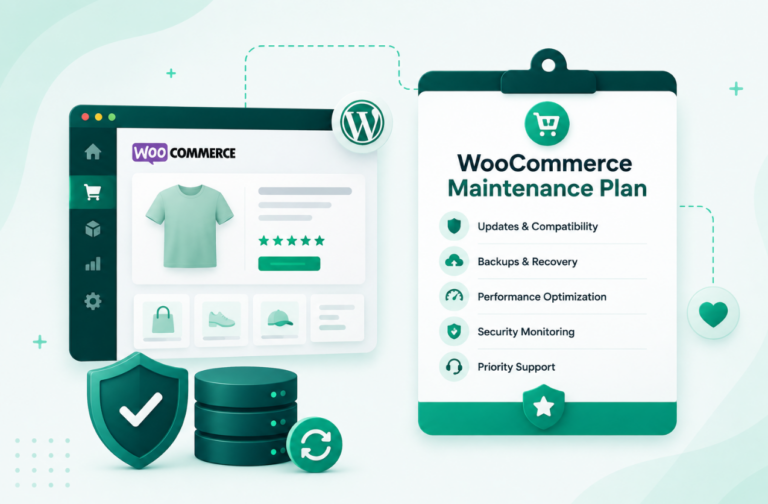
WordPress care plans are recurring website maintenance packages where an agency keeps client sites updated, backed up, monitored, secure, and performing well after launch. For agencies, they turn one-time WordPress projects into predictable monthly revenue. For clients, they remove the stress of managing updates, security issues, downtime, backups, and small technical fixes on their own.
The best WordPress care plans are not vague “we maintain your site” offers. They are clearly scoped WordPress maintenance plans with defined deliverables, reporting, response times, exclusions, and upgrade paths. This guide breaks down what to include, how to price your packages, how to structure WooCommerce care plans, and how agencies can deliver care plans faster.
Table of Contents
Key Takeaway

A WordPress care plan should include updates, backups, uptime monitoring, security checks, performance reviews, support boundaries, and monthly reporting.
Pricing should reflect site complexity, risk, plugin stack, business impact, support time, and whether the site processes orders or leads.
WooCommerce care plans need extra checks for checkout, payments, order emails, backups, database performance, and recovery workflows.
InstaWP helps agencies deliver WordPress care plans with staging, snapshots, hosting, monitoring, site management, and WordPress maintenance reports.
What Is a WordPress Care Plan?
A WordPress care plan is a recurring service where an agency manages the ongoing health of a client’s WordPress website. It usually includes WordPress core updates, plugin updates, theme updates, backups, uptime monitoring, malware or vulnerability checks, performance checks, small content or support tasks, and monthly reporting.

In simple terms, a WordPress care plan is the post-launch operating system for a client site. The client pays monthly or annually, and your agency handles the technical work that keeps the website stable, secure, and useful.
This is different from a one-time website project. A project ends at launch. A care plan starts after launch and keeps the client relationship active. That is why agencies use WordPress care plans to improve client retention, create recurring revenue, and reduce emergency support work.
Why Agencies Should Offer WordPress Care Plans
WordPress care plans are valuable because clients rarely want to manage WordPress themselves. They do not want to test plugin updates, check uptime, review backups, troubleshoot slow pages, scan for vulnerabilities, or figure out why a form stopped working. They want the site to work.
For agencies, this creates a strong service opportunity. Instead of waiting for clients to come back with random requests, you can offer a structured monthly package that keeps the website maintained and keeps your agency involved.
Recurring Revenue Instead of Project-Only Income
Project revenue is unpredictable. A strong month can be followed by a quiet one. WordPress maintenance packages give agencies a more stable revenue base because clients pay every month for ongoing website care.
This changes the agency model. You stop treating maintenance as unpaid follow-up work and turn it into a defined recurring service with scope, deliverables, and profit margin.
Better Client Retention
When you maintain a client’s site every month, you stay close to the business. You send reports, flag risks, suggest improvements, and become the team responsible for keeping the website reliable. That makes it harder for clients to drift away after launch.
More Upsell Opportunities
Care plans naturally lead to higher-value services. Once a client trusts you with maintenance, it is easier to recommend managed WordPress hosting, performance optimization, SEO support, conversion improvements, landing pages, WooCommerce improvements, or a Website as a Service model.
The key is to use reporting as proof. When clients can see what was updated, monitored, backed up, and improved, they understand the value of the work and are more open to the next step.
What Should a WordPress Care Plan Include?
A good WordPress care plan should be specific. Do not sell “peace of mind” without explaining what creates that peace of mind. Clients should know exactly what is included, how often it happens, and what is outside scope.
The 8-Part WordPress Care Plan Stack
A complete care plan should cover more than updates. It should protect the full site lifecycle.
Core, plugins, themes, compatibility checks.
Scheduled restore points and recovery process.
Vulnerability scans, malware checks, hardening.
Uptime, performance, alerts, logs.
Caching, images, database, Core Web Vitals checks.
Monthly client-ready maintenance summaries.
Defined response times and support limits.
SEO, conversion, landing pages, WooCommerce improvements.
This is where InstaWP can become part of the agency delivery stack. Instead of maintaining every site manually, agencies can use InstaWP to centralize site access, create WordPress staging sites before risky updates, generate backups and restore points, monitor sites, and create client-facing maintenance reports.
WordPress Care Plan Packages Agencies Can Sell
Most agencies should offer three WordPress maintenance plan tiers. Three options are easy to understand and make it clear which clients need basic care, which need growth support, and which need advanced business or WooCommerce coverage.
Sample WordPress Care Plan Packages
Use three clear tiers so clients can choose based on risk, support needs, and business impact.
Essential
Best for brochure sites
- Core/plugin/theme updates
- Scheduled backups
- Basic uptime monitoring
- Monthly maintenance report
- Limited support time
Growth
Best for lead-gen sites
- Everything in Essential
- Staging before major updates
- Performance checks
- Security/vulnerability scans
- More support time
Business / WooCommerce
Best for revenue sites
- Everything in Growth
- Checkout/order-flow testing
- Priority support
- Advanced monitoring
- Revenue recommendations
How to Price WordPress Maintenance Plans
WordPress care plan pricing should not be based only on task count. It should be based on risk, responsibility, and the amount of operational work your agency is taking on.
| Pricing factor | Lower-cost plan | Higher-cost plan |
|---|---|---|
| Site type | Brochure site or portfolio | WooCommerce, LMS, membership, marketplace |
| Plugin stack | Few common plugins | Many plugins, custom code, integrations |
| Business impact | Informational site | Revenue, leads, bookings, or orders |
| Update risk | Simple theme and plugin stack | Custom checkout, subscriptions, page builders, custom fields |
| Support expectation | Limited monthly support | Priority support and frequent changes |
| Reporting need | Basic maintenance summary | Detailed report with strategic recommendations |
If the client expects your agency to protect revenue, respond quickly, test updates, maintain backups, monitor uptime, and explain the work every month, the plan should be priced as an operational service, not a simple update checklist.
Agencies that bundle managed cloud hosting with care plans can also reduce support friction. When sites are scattered across low-quality hosting accounts, every issue takes longer to diagnose. A standardized hosting and maintenance stack is easier to support and easier to scale.
How InstaWP Helps Agencies Deliver WordPress Care Plans
WordPress care plans become profitable when the work is repeatable. If your team logs into every site manually, tracks updates in spreadsheets, creates reports by hand, and tests changes directly on live sites, margins disappear quickly.
InstaWP gives agencies a more efficient way to deliver WordPress maintenance plans from one platform. You can build and test sites in cloud sandboxes, create WordPress staging sites before risky changes, save snapshots, launch client sites on managed WordPress hosting, monitor site health, and manage ongoing care plan work from a central dashboard.
If you’re on its managed WordPress hosting, you can simply generate the mainteance report for your clients over a single click. Go to Manage and click on ‘Generate Report’.
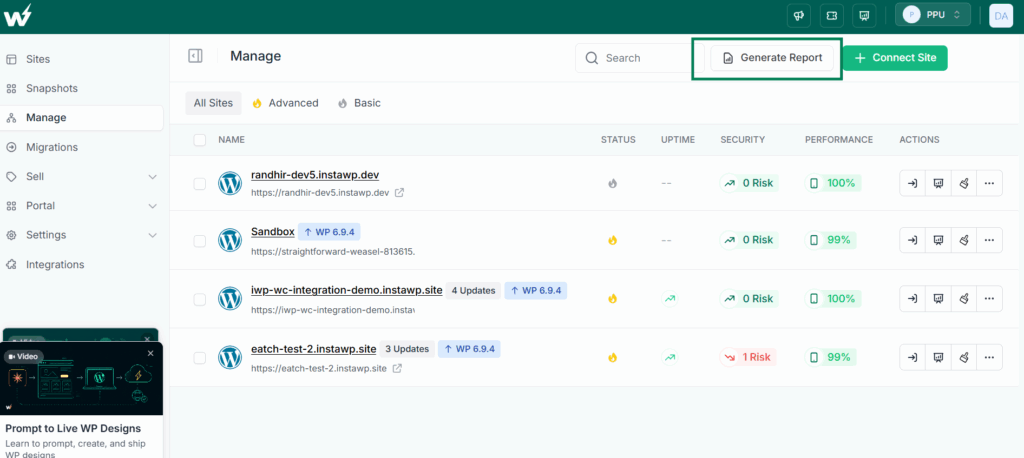
The biggest advantage is that InstaWP connects the operational parts of a care plan: testing, monitoring, hosting, reporting, and client communication. Instead of selling maintenance as a vague monthly task, agencies can show a structured workflow that keeps every managed site easier to maintain and easier to report on.
InstaWP Care Plan Delivery Workflow
InstaWP Care Plan Delivery Workflow
A repeatable workflow for delivering care plans without managing every client site manually.
Use InstaWP Maintenance Reports to Show Monthly Value
The most important product-led section for this article is WordPress maintenance report generation. Maintenance work is often invisible to clients unless you show it clearly. InstaWP helps agencies create client-ready maintenance reports that summarize completed updates, site activity, uptime, backups, and maintenance work.
This matters because reports reduce the “what are we paying for?” problem. Instead of telling clients that you maintained the site, you can show what changed, what was monitored, what was backed up, and what needs attention next. That makes renewals and upsells much easier.
For example, a monthly report can support a simple client conversation: “We updated your plugins, confirmed the site stayed online, reviewed performance, checked for vulnerabilities, and recommend improving image delivery next month.” That is a much stronger value story than “we did maintenance.”
Test Risky Updates in Staging
Plugin and theme updates can break layouts, forms, checkout pages, or custom functionality. With InstaWP, agencies can use WordPress staging sites to test risky changes before pushing them to production. That makes your WordPress maintenance plans safer and easier to justify at higher tiers.
Bundle Hosting With Care Plans
Many agencies improve margins by bundling care plans with managed WordPress hosting. When your agency controls the hosting environment, it is easier to troubleshoot performance, backups, SSL, redirects, caching, and uptime issues.
This does not mean every care plan must include hosting, but hosting gives agencies more control over the quality of the service. It also makes the offer easier for clients to understand: one partner handles the site, hosting, updates, monitoring, and reports.
Turn Care Plans Into WaaS Revenue
For agencies that want to productize recurring revenue, Website as a Service is the next step. Instead of selling only custom builds and maintenance, you can create repeatable website templates for a niche and sell them with hosting, updates, reports, and support bundled into a monthly plan.
This works well for local businesses, coaches, clinics, restaurants, service providers, and other niches where clients need a reliable site but do not want a custom development process every time.
WooCommerce Care Plans Need Extra Coverage
A WooCommerce care plan should not be priced or scoped like a basic WordPress care plan. Stores change constantly because of orders, customer data, inventory, coupons, payments, and shipping rules. They also have more plugins and more revenue-critical workflows.
At minimum, WooCommerce care plans should include checkout testing after major updates, payment gateway checks, order email checks, cart and checkout review, stronger backup rules, performance checks, and priority restore support.
For WooCommerce stores, InstaWP’s staging and hosting workflows are especially useful. Agencies can test checkout changes away from production, review performance before campaigns, and use maintenance reports to show store owners that their revenue-critical workflows are being monitored.
What Not to Include in a WordPress Care Plan
A profitable WordPress care plan needs boundaries. Without boundaries, it becomes unlimited support with a fixed monthly price.
- Do not include unlimited redesign requests.
- Do not include large new feature builds unless the plan is priced for development time.
- Do not include SEO content writing unless it is explicitly part of the package.
- Do not include custom plugin development in a basic maintenance plan.
- Do not promise 24/7 emergency support unless the client pays for that response level.
- Do not guarantee third-party plugin or SaaS behavior outside your control.
The cleanest model is simple: maintenance, monitoring, backups, reports, and defined support are included. Larger changes become project work, support retainers, or a higher-tier care plan.
How to Sell WordPress Care Plans to Clients
Clients do not buy plugin updates. They buy fewer problems, better reliability, safer changes, faster recovery, and a team that keeps the website working while they run the business.
How to Pitch a WordPress Care Plan
Sell the business outcome, not the task list.
“We update your plugins every month.”
This sounds like a small task and invites price comparison.
“We keep your WordPress site updated, backed up, monitored, tested, and reported on every month.”
This frames the plan as risk reduction, operational support, and peace of mind.
If you use InstaWP, this pitch becomes easier. You can explain that the site is maintained through a repeatable workflow: staging before risky updates, managed hosting where needed, uptime and vulnerability checks, backups, and monthly reports that show the work clearly.
WordPress Care Plan Checklist for Agencies
- Audit the site before accepting it into a care plan.
- Define the plan tier and what is included.
- Set update frequency and staging rules.
- Confirm backup frequency and retention.
- Add uptime monitoring and vulnerability checks.
- Create a monthly maintenance report template.
- Document support limits and exclusions.
- Use a staging workflow for risky updates.
- Add WooCommerce-specific checks for stores.
- Review profitability every quarter.
Agencies that want a more scalable model can also explore the InstaWP Agency Program and review InstaWP pricing to package care plans, hosting, site management, and WaaS more predictably.
Conclusion: Turn Maintenance Into a Scalable Agency Offer
WordPress care plans are one of the clearest ways for agencies to create recurring revenue after launch. The best plans are specific, profitable, and easy for clients to understand. They include updates, backups, monitoring, security checks, performance reviews, support boundaries, and maintenance reports.
InstaWP makes the delivery side easier by helping agencies build, test, host, manage, monitor, and report on WordPress sites from one cloud-first workflow. That means your care plans can be more than manual maintenance. They can become a repeatable service system for client retention, hosting revenue, WooCommerce support, and WaaS growth.
Start with InstaWP to create faster WordPress care plan workflows, generate client-ready maintenance reports, and scale recurring agency revenue without stitching together separate tools.
FAQs About WordPress Care Plans
u003cstrongu003eWhat is a WordPress care plan?u003c/strongu003e
A WordPress care plan is a recurring maintenance service where an agency manages updates, backups, monitoring, security checks, performance reviews, support, and reporting for a client’s WordPress website.
u003cstrongu003eWhat should be included in a WordPress maintenance plan?u003c/strongu003e
A WordPress maintenance plan should include WordPress core updates, plugin and theme updates, backups, uptime monitoring, security checks, vulnerability scans, performance checks, support boundaries, and a monthly maintenance report.
u003cstrongu003eHow much should agencies charge for WordPress care plans?u003c/strongu003e
Agencies should price WordPress care plans based on site complexity, update risk, business impact, plugin stack, support expectations, and reporting needs. WooCommerce and membership sites should usually cost more than brochure websites.
u003cstrongu003eAre WordPress care plans profitable?u003c/strongu003e
Yes. WordPress care plans can be profitable when the scope is clear and the workflow is repeatable. Profit drops when agencies offer unlimited support, manage sites manually, or fail to report the value they deliver.
Do WooCommerce stores need separate care plans?
Yes. WooCommerce stores need extra checks for checkout, payments, order emails, backups, database performance, plugin compatibility, and recovery because website issues can directly affect revenue.