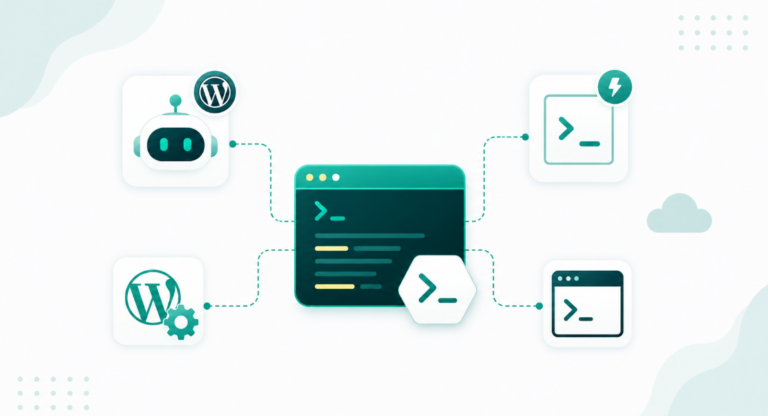
The way developers interact with WordPress is changing. With tools like Claude, GPT, and open-source LLMs becoming more capable, the idea of a WordPress AI agent, one that can manage content, update settings, handle maintenance tasks, and more, is no longer theoretical. It’s something you can build today.
But here’s the challenge every developer hits: where do you safely test an AI agent that has write access to WordPress?
You can’t point a half-built AI agent for WordPress at a client’s live site and hope for the best. One bad API call and you’ve unpublished their entire blog, deleted a WooCommerce product catalog, or broken a page layout in front of real visitors.
Whether you’re exploring AI agent WordPress automation for the first time or looking to build the best WordPress AI agent for your clients, this guide covers the complete process.
Table of Contents
Key Takeaway

A WordPress AI agent is an LLM-powered tool that executes real actions on a WordPress site like publishing posts, managing categories, and updating settings through natural language commands.
Building an AI agent for WordPress doesn’t require custom plugin development or complex API integrations. You need an AI model (like Claude), a WordPress site, and a WordPress MCP connection between the two. If the site is hosted elsewhere, pick a connection from the best WordPress MCP plugins.
InstaWP provides both the staging environment and the MCP server out of the box; giving your AI agent a safe sandbox to operate in and a ready-made connection layer to WordPress.
The development workflow follows a simple loop: create a site on InstaWP, connect it to Claude via MCP, define agent behavior through a system prompt, test against real WordPress data, and iterate until reliable.
What Exactly Is a WordPress AI Agent?
Before diving into the how, let’s define what we mean. A WordPress AI agent is an LLM-powered tool that can take real actions on a WordPress site through natural language instructions.
Instead of logging into wp-admin and clicking through menus, you tell the agent what you want, and it executes. This is what makes an AI agent for WordPress fundamentally different from a basic chatbot or assistant.
Some practical examples of what an AI agent for WordPress can do:
- Unpublish or schedule posts based on a verbal command
- Bulk-update categories, tags, or metadata across dozens of posts
- Install and activate plugins
- Create new pages with specific content structures
- Toggle maintenance mode on or off
- Update theme files or plugin settings
- Generate and assign taxonomy terms on the fly
The key difference between a WordPress AI agent and a simple chatbot is execution. The agent doesn’t just suggest what to do, it actually does it. It connects to your WordPress instance, calls the right APIs, and modifies real data.
This is powerful, but it also means mistakes have real consequences, which is why the testing environment matters so much.
How Build a WordPress AI Agent: Step-by-step Guide

When you plan to build a WordPress AI agent, the process is simpler than you might expect; you don’t need to write a custom plugin, build a REST API wrapper, or set up complex authentication flows from scratch.
The core ingredients are straightforward: an AI model that can reason and execute tasks (like Claude), a WordPress site to operate on, and a connection layer between the two. That connection layer is MCP (Model Context Protocol), a standardized protocol that lets AI agents talk to external tools and services.
What you’re really building is the behavior layer: telling the agent what it can do, how it should handle edge cases, and what it should never touch. The WordPress site and MCP handle the rest.
Here’s how to go from zero to a working WordPress AI agent, step by step.
Step 1: Prerequisites
Before you start building a WordPress AI agent, make sure you have the following ready:

An InstaWP account
InstaWP , the all-in-one-cloud for WordPress, plays two critical roles in your AI agent development workflow. First, it gives you instant staging sites, disposable WordPress environments where your agent can execute real actions without any risk to live client sites.
Second, every InstaWP site comes with a built-in WordPress MCP (Model Context Protocol) server for every site. MCP is the standardized protocol that lets AI agents communicate with external tools and services.
What this means in practice: your AI agent doesn’t need custom REST API integration, OAuth setup, or hand-rolled authentication flows. The MCP server exposes WordPress actions, listing posts, updating content, managing taxonomies, handling plugins, as structured tools that the agent can call directly.
For developers building the best WordPress AI agent they can, this removes an enormous amount of plumbing work. You don’t build the connection layer; it’s already there. This is what makes InstaWP a natural fit for any AI agent WordPress project.
Without this, you’d need to build custom API integrations from scratch. InstaWP handles both the WP sandbox and the connectivity, so you can focus entirely on building the agent’s behavior.
If you’re an agency handling multiple WordPress sites, building an AI agent for WordPress with InstaWP is way more easy as it lets you save site templates that mirror specific client setups, particular themes, plugin stacks, PHP versions, content structures.
When testing your AI agent WordPress workflows, you can spin up an environment that matches Client A’s exact configuration, test the agent there, then spin up Client B’s environment and test again. Same agent, different contexts, real validation.
Claude Desktop or Claude Code
This is the AI layer where your WordPress AI agent will live. Download Claude Desktop for a visual interface, or use Claude Code if you prefer CLI-based workflows. Claude connects to your InstaWP staging site through the MCP server and uses the exposed WordPress actions as callable tools.
Node.js and npm installed
Required if you’re using Claude Code for the MCP connection setup.
A clear use case in mind
Know what you want your AI agent for WordPress to do. Start simple, managing posts, updating categories, toggling plugin status. You can always expand the agent’s capabilities later as you test and iterate.
Step 2: Create a Staging Site on InstaWP
Go to InstaWP and spin up a new WordPress site. If you’re building for a specific client, create a template that mirrors their setup, same theme, plugins, PHP version, and content structure.
Must Read: Create Site | InstaWP Docs
Make sure the site has real content to work with, a few published posts, some categories, a page or two. Your WordPress AI agent needs actual data to test against, not an empty install.
Once the site is ready, go to its detailed page and enable MCP server on it. It’s in the left-hand menu inside the InstaWP dashboard.

Click on MCP > Enable. What’s worth noting here is if your site is not running on PHP 8.2+ version then you won’t be able to enable MCP server. You’ll get this kind of notification.

Updating PHP version is just a matter of a few clicks on InstaWP. Just click on “Upgrade PHP Version” and change the version from the drop down. Here is how you can update PHP version of your site on InstaWP.

Once your site is running on a compatible PHP version, you’ll be able to view the ‘Enable’ option. Slide it and MCP server will be enabled. Copy the MCP URL.

Step 3: Connect the MCP Server to Claude
We’re using Claude to create a WordPress AI agent but you can use ChatGPT as well. Make sure you’re on a ChatGPT plan that supports custom connectors.
To connect the MCP server with Claude, go to Settings > Connectors > Add Custom Connectors.

Name your WordPress AI agent and paste the MCP URL you copied in the Step 2 from the InstaWP dashboard.

That’s it! The WordPress AI agent is now ready. Next, you need to configure it.
Step 4: Configure Your WordPress AI Agent
You can configure the capabilities of your AI agent for WordPress, based upon your goals. Go to the agent and decide the permissions you want to grant to the agent.

If you choose Custom then you can always allow, restrict, or block a specific functionality.

For the sake of this guide, we’re choosing Always Allow so the WordPress AI agent we’ll always have the permissions to perform all the activities, based upon the commands you’re giving.
Step 5: Define Your Agent’s Behavior
Nwo, you need to definethe behaviour of your WordPress AI agent. Write a system prompt that tells Claude how to behave as your AI agent WordPress tool. This is where you set the rules, capabilities, and guardrails:
You are a WordPress content management agent connected to a client’s site.
Capabilities:
- List, publish, unpublish, and edit posts and pages
- Create and assign categories and tags
- Manage plugin activation statusRules:
- Always confirm the exact post title before making changes
- If multiple posts match, list them and ask which one
- Never permanently delete content — only draft or trash
- After every action, verify the change was applied
- If a category or tag doesn't exist, create it first, then assign itThis prompt is the blueprint. It determines how your WordPress AI agent handles ambiguity, errors, and edge cases.
Step 5: Test on the Staging Site
Now that you have the WordPRess AI agent ready, you need to test it. Open Claude and try giving your agent real commands such as:
– “List all published posts”
– “Unpublish the post titled ‘Summer Sale 2025′”
– “Assign category ‘Tutorials’ to post ID 42”
– “Republish the last post you unpublished”
Every action executes against the real InstaWP site. Check wp-admin to verify results.

Step 6: Refine the System Prompt
Based on what you learned in testing, tighten the rules. For example, if the agent didn’t handle duplicate titles well, add:
- If more than one post matches the query, present the full list with
- IDs and dates. Ask the user to specify by ID. Never assume.
Each round of testing reveals new edge cases. Each refinement makes the agent smarter and safer.
Step 7: Deploy to Production
Once the agent works reliably, enable the MCP server the client’s live site. Same agent, same prompt, same behavior, now running on real data with confidence because it was already tested against a matching environment.
If you’re an agency building AI agents for WordPress across multiple clients, this workflow scales naturally.
Each client gets their own InstaWP template. Each AI agent for WordPress you build gets tested against the specific environment it’ll operate in. You can run parallel testing, one developer tests the content management agent on Client A’s template while another tests the SEO agent on Client B’s template.
The MCP server integration means you’re not rebuilding connection logic for every client. The protocol is standardized. The WordPress actions are exposed the same way regardless of the client’s theme, plugin stack, or hosting configuration.
And because InstaWP environments are disposable, your testing costs are effectively zero. No infrastructure to maintain, no cleanup required, no risk of cross-contaminating client environments.
Benefits of Using InstaWP for Agencies to Stay Ahead in the AI for WordPress Era
The agencies that will win in the next few years aren’t the ones writing the most code, they’re the ones that ship faster, test smarter, and automate what used to take hours of manual wp-admin work.
Building a WordPress AI agent is becoming a competitive advantage. An agency that can offer clients an AI agent for WordPress, one that handles content updates, plugin management, routine maintenance, and reporting, delivers more value at lower cost than an agency doing all of that manually.
The client gets faster turnaround. The agency frees up developer time for higher-value work.
But here’s the thing: you can’t build reliable AI agents without a reliable testing infrastructure.
Every WordPress AI agent you build needs to be tested against real WordPress environments, not mocked APIs, not local sandboxes with no MCP support, not “it probably works” assumptions. It needs to be tested against environments that match your client’s exact setup, where failures cost nothing and iteration is instant
This is where InstaWP becomes a strategic advantage, not just a convenience:

- Speed to prototype — Spin up a staging site in seconds, connect your AI agent via MCP, and start testing immediately. Agencies that can go from idea to working AI agent WordPress prototype in a single afternoon will outpace those still configuring local environments.
- Client-specific validation — Save InstaWP templates for each client. When you build a new WordPress AI agent or update an existing one, test it against that client’s exact theme, plugin stack, and content structure. This is how you avoid the “it worked in testing but broke on their site” problem.
- Scale without infrastructure overhead — You’re not maintaining staging servers, managing Docker containers, or paying for always-on test environments. InstaWP sites are on-demand. Spin up ten client environments for parallel testing, tear them all down when you’re done. Your infrastructure cost stays near zero while your testing coverage scales with your client roster.
- MCP as the foundation — Every InstaWP site ships with an MCP server. This means every new AI agent for WordPress you build, whether it’s a content manager, an SEO assistant, a WooCommerce operator, or a maintenance bot, connects the same way. One protocol, one workflow, every client. That consistency compounds as you grow your AI agent library.
- First-mover positioning — Most agencies haven’t started building WordPress AI agents yet. The ones who start now, who invest in the workflow, build a library of tested agents, and offer AI-powered WordPress management as a service, will be the ones clients gravitate toward. InstaWP gives you the platform to start building today, not after six months of setting up infrastructure.
The agencies that treat AI agent WordPress development as a core capability, not a side experiment, are the ones that will define the next chapter of WordPress services. InstaWP is the infrastructure layer that makes that possible without slowing you down.
What’s Next for WordPress AI Agents
The ecosystem around AI agent WordPress development is evolving fast. Projects like WordPress/agent-skills are creating standardized skill sets for AI agents. MCP adoption is growing across the developer tools landscape. And the agents themselves are getting better at handling complex, multi-step WordPress AI agent workflows.
For developers and agencies who want to be ahead of this curve, the foundation is simple: you need a safe, fast, API-connected environment to build and test in. InstaWP provides exactly that, staging sites for sandbox testing, MCP servers for agent connectivity, and templates for client-specific validation.
The best WordPress AI agent isn’t the one with the most features. It’s the one that was tested thoroughly enough to be trusted with real client work. And that testing starts on InstaWP.
Ready to start building your own WordPress AI agent? Sign-up with InstaWP today, claim free $25 credits, create a InstaWP site, and connect it to Claude via MCP to start building the best WordPress AI agent for your clients today.
FAQs
What is a WordPress AI agent?
A WordPress AI agent is an LLM-powered tool that can take real actions on a WordPress site through natural language commands. Unlike a chatbot that only gives suggestions, a WordPress AI agent actually executes tasks, publishing posts, managing categories, updating plugin settings, and more, by connecting to your WordPress site through protocols like MCP.
Do I need to know how to code to build an AI agent for WordPress?
Not necessarily. The workflow described in this guide is primarily prompt-based. You define the agent’s behavior through a system prompt, and the MCP server handles the connection between Claude and WordPress.
Why can’t I just test my WordPress AI agent on a local setup like XAMPP or LocalWP?
You can, but local setups don’t come with a built-in MCP server. You’d need to set up the connection layer yourself. InstaWP provides both the WordPress environment and the MCP integration out of the box, which significantly reduces setup time. Additionally, InstaWP sites are cloud-hosted, so they better reflect real hosting conditions your client’s site will run on.
What is MCP and why does it matter for building WordPress AI agents?
MCP (Model Context Protocol) is a standardized protocol that allows AI agents to communicate with external tools and services. For WordPress AI agent development, MCP is what lets Claude (or another AI model) call WordPress actions like listing posts, updating content, or managing plugins, without you having to build a custom REST API integration. InstaWP provides an MCP server with every staging site, so the connection layer is ready from day one.
Can I build the best WordPress AI agent using free tools?
Yes. Claude offers free-tier access, and InstaWP gives you $25 in credits when you add a card, enough to run a $2-a-month Sandbox staging site. The MCP server comes included with InstaWP sites at no extra cost. You can build, test, and refine a fully functional AI agent for WordPress without paying anything upfront.
What tasks can a WordPress AI agent handle?
It depends on how you configure it, but common use cases include publishing and unpublishing posts, scheduling content, creating and assigning categories or tags, activating or deactivating plugins, updating page content, managing WooCommerce products, and bulk-editing metadata. The MCP server exposes a wide range of WordPress actions, so the agent’s capabilities grow with what you define in the system prompt.