White label WordPress means selling hosting, maintenance, support, and even entire websites under your own agency brand, while a platform like InstaWP powers everything invisibly in the background.
Your client sees your logo, your domain, your dashboard, and your emails. They never see the company actually running the infrastructure. This is how agencies turn one-time website projects into recurring, brand-owned revenue without hiring a single server engineer.
This guide covers exactly what white labeling means for a WordPress agency, the three things you can white label (hosting, maintenance, and full site delivery), how each one actually works at a technical level, and how to set it all up so your brand sits on top and the plumbing stays hidden.
Table of Contents
Key Takeaway
- White labeling lets your agency sell WordPress hosting, maintenance, and sites under your own brand while a provider runs the tech invisibly.
- There are three layers you can white label: hosting, maintenance and support, and full site delivery (WaaS). Most agencies stack all three.
- With InstaWP, your brand shows up everywhere clients look: a white-label suffix domain, a branded client portal, branded login screens, and branded PDF reports.
- Done right, white labeling improves client retention, increases perceived value, and unlocks recurring margin on work you already do.
What Is White Label WordPress?
White label WordPress is a model where your agency resells WordPress services (hosting, maintenance, support, or complete websites) under your own brand, while a third-party platform handles the technical delivery behind the scenes. The end client has no idea another company is involved. They interact only with your branding, your communication, and your service.
The term comes from manufacturing, where a “white label” product is made by one company and sold under another company’s brand. In WordPress, the same idea applies. You are not building data centers or writing security patches. You are packaging professionally-run infrastructure as your own offering, setting your own prices, and keeping the client relationship entirely yours.
There is an important distinction worth clearing up early. Most white label providers in the WordPress space are outsourcing companies: you hand them a ticket, their team does the work, and they stay invisible. That works, but it means you are dependent on someone else’s team and turnaround time.
InstaWP takes a different approach. It is a white label platform, which means you control the dashboard, the work happens through automation you operate, and you are not waiting on anyone. You get the brand invisibility of white labeling with the independence of running it yourself.
Why White Labeling Matters for Agencies
If you build WordPress sites for clients, you have almost certainly handed off hosting to a third party at some point. The moment you do, three things happen, and all of them hurt your agency.
First, you lose the recurring revenue. The client pays the host every month, not you, for infrastructure running the site you built.
Second, you lose control of the relationship. When the host has an outage or sends a confusing renewal email, your client sees another company’s name and starts to wonder who they are actually working with.
Third, you lose perceived value. An agency that says “I’ll build your site, then go sign up at Bluehost” looks like a freelancer. An agency that says “your site lives on our managed platform, here is your dashboard” looks like a real business.
White labeling fixes all three. The revenue is yours, the relationship is yours, and the perceived value goes up because everything carries your name. Here is what that translates to in practice.
What Your Client Sees vs. What Is Actually Powering It
The whole point of white labeling is the gap between what your client experiences and what is actually running underneath. Here is that gap made visual.
Your client logs into client.youragency.com, sees your branding everywhere, and assumes you built and run the whole thing. In reality, InstaWP is doing the heavy lifting and never shows its name. That gap is the entire business model.
Want to see how agencies set this up end to end?
The InstaWP Agency Program walks you through white-label setup, gives you a dedicated account manager, and includes free migration of your existing client sites.
Explore the Agency Program →The Three Layers You Can White Label
Agencies often think of white labeling as one thing, but it is really three separate layers you can offer independently or stack together. Most successful agencies stack all three, because each one reinforces the others and increases what a single client is worth to you.
1. White Label WordPress Hosting
White label WordPress hosting means you sell managed hosting under your brand, set your own prices, and keep the difference between what you charge clients and what the platform charges you. The client never knows the underlying provider exists.
This is the foundation layer, and it is where InstaWP’s white label managed WordPress hosting is purpose-built for agencies. Here is what makes hosting genuinely white label, not just “hosting you happen to resell.”
White-label suffix domains
Instead of client sites living on something.instawp.app, you configure your own suffix domain so every site you provision sits on client.youragency.com or sites.youragency.com. This single setting is what makes the hosting feel like your own platform rather than a reseller account. Your clients see your domain in the address bar of their dashboard from the very first login.
Pay-per-site pricing so margins are clean
You only pay for the sites that are active, billed daily. There is no reseller pack to pre-purchase and no minimum commitment. InstaWP plans run from $2/month (Sandbox) to $45/month (Elite).
If you host a client on the $9/month Plus plan and charge them $49/month for hosting, your margin is $40/month per site, and it is 100% yours. Because billing is per-site and daily, your costs scale exactly with your client base, never ahead of it.
The full managed stack, invisible to clients
Every site you resell comes with the InstaCDN global content delivery network, InstaShield security (WAF, DDoS protection, and auto-provisioned SSL), automated backups, and object caching on Plus plans and above. Your client gets enterprise-grade infrastructure and credits your agency for it, because your brand is the only one they ever see.
Did you know? Because InstaWP bills per active site per day, you can spin up a client’s site, let them review it, and only start paying once it goes live. There is no wasted spend on sites sitting in limbo, which keeps your white label hosting margins tight.
2. White Label WordPress Maintenance and Support
White label WordPress maintenance is the recurring care layer: the updates, backups, security scans, and monitoring that keep client sites healthy, all delivered under your brand. White label WordPress support is its reactive twin: the on-demand fixes when something breaks. Agencies should offer both, and they pair naturally into a single monthly care plan.
The reason maintenance is such a strong white label product is that clients pay $100 to $300 per month for it but rarely see the work. The agencies that win are the ones who make the invisible work visible (through branded reports) while keeping the delivery effortless. Here is how to manage WordPress sites across an entire client portfolio without it eating your week.
Bulk updates across every client site
Using the InstaWP Connect plugin (free from WordPress.org), you connect any WordPress site, even ones not hosted on InstaWP, and run plugin, theme, and core updates across dozens of sites in a single action. What used to be an afternoon of logging into individual wp-admins becomes one click from one dashboard.
Scheduled vulnerability and performance scans
Set vulnerability scans and performance audits to run automatically across your portfolio. Instead of reacting to a hacked site, you catch outdated plugins and known CVEs before they become a 2am emergency. This is the proactive layer that lets you charge premium maintenance prices with a straight face.
Branded PDF reports that justify the retainer
This is the detail most agencies miss. InstaWP generates client-ready PDF reports showing updates applied, scans run, uptime, and performance, and you can brand them with your agency’s identity. Sending a polished monthly report with your logo is what turns “why am I paying you $200 a month?” into “this is clearly worth it.” The maintenance work is automated, but the perceived value is high.
Uptime monitoring and alert rules
Configure uptime monitoring with custom alert rules so you know the moment a client site goes down, ideally before the client notices. Being the one who says “we already spotted it and we’re on it” is one of the strongest retention tools an agency has.
Bundle hosting + maintenance and your margin compounds
Agencies in the InstaWP Agency Program get 50% cashback on migrated sites for the first six months, plus free migration help to move your existing clients onto your white-label setup.
See Agency Program perks →3. White Label Full Site Delivery (WaaS)
The third and most advanced layer is white labeling entire websites, not just the infrastructure under them. This is Website as a Service (WaaS), and it is where white labeling stops being a cost-saving tactic and becomes a product business.
Here is the model. You build a great WordPress site once (say, a polished template for dentists or restaurants), save it as a reusable template, and then sell it on a subscription.
A client signs up through your branded portal, a fully configured site provisions automatically on your suffix domain, and they pay you monthly for the site plus hosting plus maintenance, all bundled. You built it once and you sell it repeatedly.
Everything in the WaaS flow is white labeled. The storefront carries your branding. The sign-up emails come from you. The customer portal shows your logo. The provisioned sites live on your domain. Your client genuinely believes you built a SaaS product, because from their side, you did. InstaWP is just the engine you never have to mention.
If the business model behind this interests you, we go deep on it in our companion guide on how to resell hosting as a WordPress agency. White labeling is the mechanism; reselling is the business model built on top of it.
How to Set Up White Label WordPress with InstaWP
Setting up white-label WordPress with InstaWP happens in two stages. First you make everything carry your brand (the white-label foundation).
Then you turn that branded setup into something customers can actually buy and pay for on a recurring basis, which is where InstaWP’s WaaS (Website as a Service) comes in. Skip the second stage and you have a branded platform but no way to sell it. Here is the full path.
Stage 1: Lay the white-label foundation
These steps make your infrastructure carry your brand instead of InstaWP’s.
Step 1: Enable White Label and add your suffix domain
From your InstaWP dashboard, open your Team Profile, go to team settings, find the White Label section, and switch on Enable White Label. Enter your suffix domain (for example, sites.youragency.com) and add it.
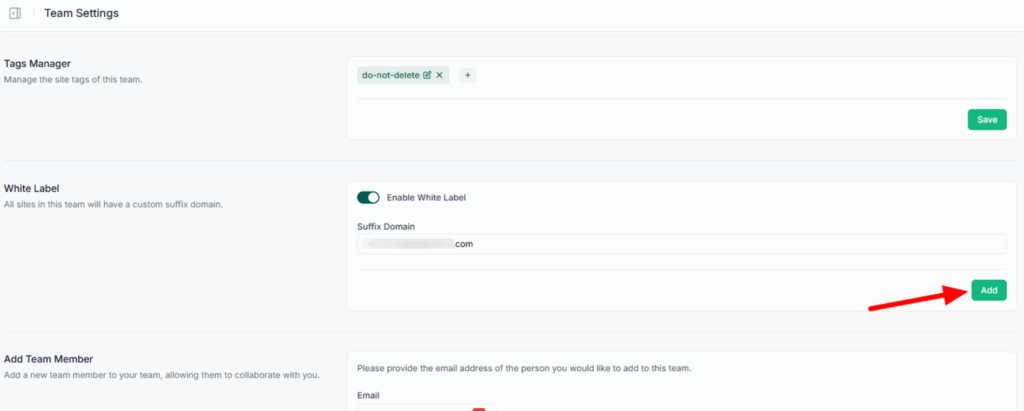
Note that the white-label suffix domain is a team add-on rather than part of the base plan.
Step 2: Point your domain via DNS
InstaWP gives you a set of NS records. Add these at your DNS provider (most agencies use Cloudflare for full DNS control), then come back and click Verify. Once verified, every site you create can be born on your domain. One technical caveat: you cannot chain nameservers, so point to InstaWP directly or use a subdomain in Cloudflare.
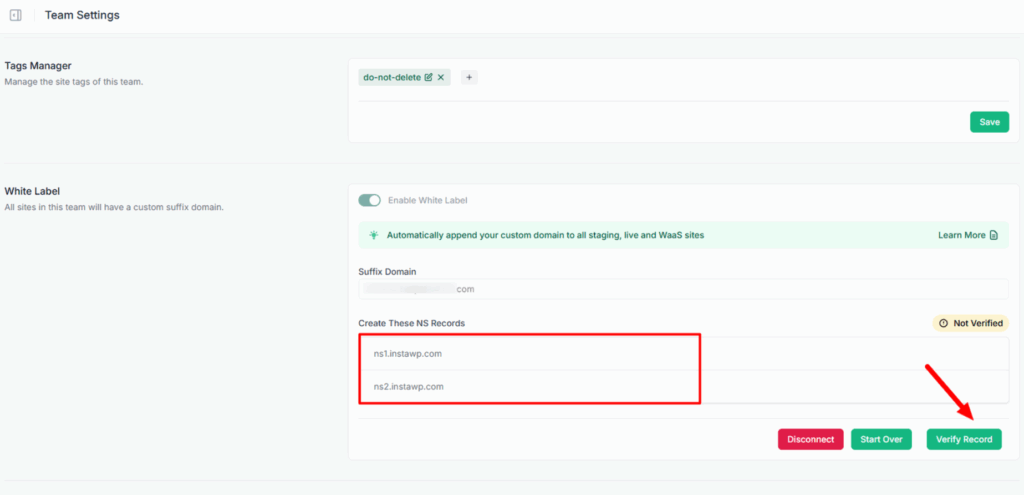
Read the full guide of adding white-label here.
Step 3: Add your branding
Upload your logo, set your brand colors, and configure email sender details so the dashboard and every client email read as your agency.
That gives you a white-labeled platform. But a branded platform is not yet a business, because there is still no way for a client to choose a plan, pay you, and get a site. That is Stage 2.
Stage 2: Turn it into a sellable hosting business with WaaS
This is the part that actually lets you sell white-label hosting. Using InstaWP’s native WaaS, you package your branded setup into plans customers can buy directly.
Step 4: Build a template
Create the site you want to sell (your product), polish it, and save it as a template. Every customer who buys gets a clone of this.
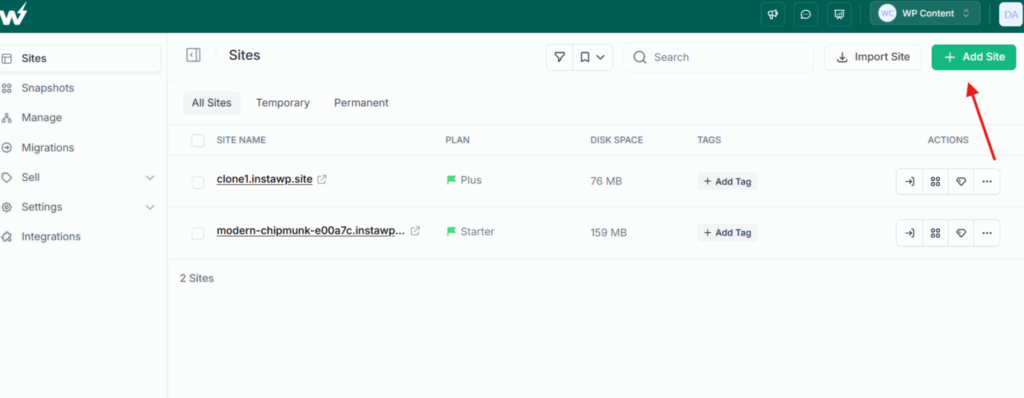
Watch the video tutorial to site creation process.
Step 5: Create your WaaS
Under the Sell menu, open WaaS and click Add New. Attach your template, set your plans and pricing (mapping each plan to an InstaWP site plan so your margin is clear), choose your currency, and add your branding to the storefront and emails. Optionally enable demo sites (30 minutes to 48 hours) so prospects can try before they buy.
Step 6: Preview and share
Preview the full checkout to confirm it works, then hit Share to get your WaaS link. That link is your storefront.
Step 7: Sell, two ways
Share the link directly so customers buy a plan and a site provisions automatically, or lead with a free demo that converts into a paid subscription. Either way, payment, provisioning, and the customer self-service portal are all handled for you, under your brand.
The honest summary: Stage 1 makes your hosting white label. Stage 2 (WaaS) makes it sellable. You need both to actually run a white-label hosting business. We cover the complete Stage 2 build, step by step, in our dedicated guide on how to sell white-label hosting with InstaWP’s native WaaS.
If you’re an agency and would rather have the InstaWP team help you set this up correctly the first time, you can book a free call here: https://calendly.com/instawp/agency-program.
How to Price White Label WordPress Services
Pricing is where agencies leave the most money on the table. The principle is simple: your client is not buying server space, they are buying peace of mind and a brand they trust. Price the outcome, not the infrastructure. Here is a realistic tiered structure you can adapt.
Costs assume InstaWP plan pricing. Your suggested prices are illustrative; agencies routinely charge more depending on client and market.
Notice the margin. Even on the Essential tier, you keep roughly $40 per site per month. Across 30 clients, that single tier alone is over $14,000 a year in recurring revenue, on infrastructure that runs itself. The work scales through automation, not headcount, which is the entire reason white labeling beats hiring an internal hosting and maintenance team.
Conclusion: Your Brand on Top, the Plumbing Hidden
White labeling is how a WordPress agency stops giving away recurring revenue and starts owning the full client relationship.
You sell hosting, maintenance, and even complete sites under your brand, your clients see only your name, and a platform like InstaWP runs the infrastructure where nobody can see it. The result is higher perceived value, stronger retention, and recurring margin on work you are largely automating.
The fastest way to get there is with a partner who sets it up with you. The InstaWP Agency Program is free to join, includes a dedicated account manager, hands you free bulk migration of your existing client sites, and gives 50% cashback on migrated sites for the first six months. It is the shortcut from “I outsource hosting” to “I run my own white-label WordPress platform.”
Put Your Brand on Top
Start white labeling WordPress under your own brand
Join the InstaWP Agency Program and we’ll help you set up your white-label hosting, maintenance, and WaaS, then migrate your existing clients for free.
Join the Agency Program →Free to join · Dedicated account manager · 50% migration cashback
Further reading
- How to Resell Hosting in 2026: A Guide for WordPress Agencies
- Website as a Service (WaaS) for WordPress
- Manage WordPress Sites from One Dashboard
- InstaWP Managed WordPress Hosting
- InstaWP for Agencies and Freelancers
Frequently Asked Questions
What does white label WordPress mean?
White label WordPress means reselling WordPress hosting, maintenance, support, or complete websites under your own agency brand while a third-party platform handles the technical delivery invisibly. Your clients only see your branding and never know another provider is involved.
What is the difference between white label WordPress hosting and maintenance?
White label hosting is the infrastructure layer (servers, CDN, security, SSL) sold under your brand. White label maintenance is the recurring care layer (updates, backups, scans, monitoring, reports). Hosting keeps the site online; maintenance keeps it healthy. Most agencies bundle both into a single monthly plan.
Do my clients ever find out I’m using InstaWP?
No. With a white-label suffix domain, branded portal, branded emails, and branded PDF reports configured, every client touchpoint carries your agency’s identity. InstaWP runs the infrastructure in the background and never surfaces its name to your clients.
Can I white label sites that are hosted somewhere else?
Yes. The InstaWP Connect plugin lets you manage WordPress sites hosted anywhere, bringing bulk updates, vulnerability scans, uptime monitoring, and branded reports into one dashboard. You do not have to migrate a site to manage it under your brand, though hosting it on InstaWP unlocks the full white-label experience.
How much can an agency charge for white label WordPress services?
White label WordPress maintenance and hosting plans typically range from $50 to $300+ per site per month depending on what you bundle. Since your underlying cost on a platform like InstaWP can be as low as per site per month, margins of 70% or higher are common and entirely yours.
Is white label WordPress only for big agencies?
No. Solo freelancers and small agencies benefit the most, because white labeling lets them look and operate like a larger, full-service business without hiring technical staff. The pay-per-site model means you can start with a single client and scale from there.