Choosing between WooCommerce and BigCommerce isn’t just a platform decision; it’s a business decision that affects every client project you deliver.
As a developer or agency, you need more than surface-level comparisons. You need to know which ecommerce platform handles custom requirements better, which scales without surprise costs, and which you can confidently hand off to clients.
This WooCommerce vs BigCommerce comparison cuts through the marketing fluff. We’ve analyzed pricing, features, flexibility, and real-world performance to help you recommend the right solution; every time.
Table of Contents
Quick Verdict: WooCommerce vs BigCommerce for Developers & Agencies

WooCommerce is the better choice if you’re building stores for clients who need full customization, already use WordPress, or want to minimize long-term platform costs. It gives developers complete control over code, hosting, and the entire tech stack; which is exactly what agencies need when creating bespoke ecommerce solutions.
BigCommerce wins when your client prioritizes speed-to-market, wants zero server management headaches, or needs enterprise-grade features without custom development. It’s the “set it and hand it off” option that works well for clients who won’t have technical teams maintaining their store.
What is WooCommerce?

WooCommerce is a free, open-source ecommerce plugin built for WordPress. It transforms any WordPress website into a fully functional online store with product management, shopping cart, checkout, and payment processing capabilities.
Launched in 2011 by WooThemes (later acquired by Automattic), WooCommerce has grown into the most popular ecommerce platform in the world. It powers over 36% of all online stores globally, making it the dominant choice for businesses of all sizes.
Because WooCommerce is self-hosted, developers and store owners have complete control over their code, hosting environment, design, and functionality. This flexibility makes WooCommerce the preferred platform for agencies building custom ecommerce solutions.
WooCommerce works by extending WordPress with selling features. You install the plugin, configure your store settings, add products, connect a payment gateway, and start selling. The core plugin is free, but most stores require premium themes, extensions, and quality hosting to function professionally.
For developers and agencies, WooCommerce offers unlimited customization potential. You can modify every line of code, build custom plugins, create unique checkout flows, and integrate with any third-party service. This level of control is impossible with hosted platforms like BigCommerce or Shopify.
The tradeoff is responsibility. With WooCommerce, you manage hosting, security, backups, updates, and performance optimization. For agencies, this creates recurring maintenance revenue. For clients without technical support, it can become a burden.
WooCommerce Key Metrics and Facts
| Metric | Data |
|---|---|
| Platform Type | Self-hosted, open-source WordPress plugin |
| Launch Year | 2011 |
| Parent Company | Automattic (also owns WordPress.com) |
| Market Share | 36%+ of all ecommerce websites |
| Active Installations | 6+ million websites |
| Core Plugin Cost | Free |
| Total Extensions Available | 1,000+ official extensions, 59,000+ WordPress plugins |
| Themes Available | 2,400+ free themes, 1,500+ premium themes |
| Payment Gateways Supported | 100+ including Stripe, PayPal, Square, Authorize.net |
| Supported Countries | 180+ countries |
| Default Product Limit | Unlimited |
| Default Variant Limit | 50 per product (expandable via code) |
| Transaction Fees | None from WooCommerce (only payment processor fees) |
| Sales Limits | None |
| Hosting Requirement | Self-managed or managed WordPress hosting |
| Technical Skill Required | Moderate to advanced |
| Best For | Custom stores, WordPress sites, budget-conscious businesses, developer-managed projects |
What is BigCommerce?

BigCommerce is a fully hosted ecommerce platform that provides everything needed to build and run an online store. It operates as a software-as-a-service (SaaS) solution, meaning the company handles hosting, security, updates, and infrastructure.
Founded in 2009, BigCommerce has positioned itself as an enterprise-ready alternative to Shopify and WooCommerce. While its market share is smaller (under 1% of all ecommerce sites), it powers approximately 39,000 stores including major brands like Sony, Skullcandy, Ben and Jerry’s, and Toyota.
BigCommerce requires no software installation. You sign up for a subscription plan, choose a theme, add products, and launch your store. The platform includes built-in features for payments, shipping, taxes, SEO, and marketing that would require separate plugins on WooCommerce.
For developers and agencies, BigCommerce offers a different value proposition. The platform handles all technical infrastructure, freeing your team from server management and security responsibilities. This makes BigCommerce attractive for clients who want a hands-off solution or lack internal technical resources.
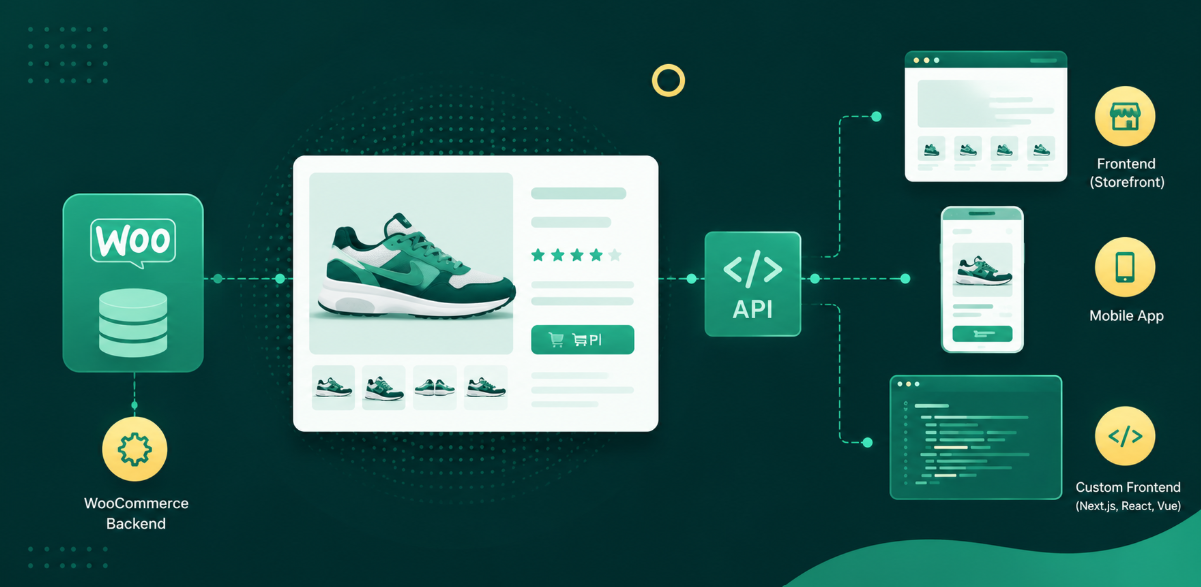
BigCommerce also provides a WordPress integration plugin. This allows developers to use WordPress as the frontend while BigCommerce handles the ecommerce backend. It is a hybrid approach that combines WordPress content management with BigCommerce selling features.
The tradeoffs are cost and control. BigCommerce charges monthly subscription fees starting at $29 per month. It also enforces annual sales thresholds that force upgrades to higher-priced plans. Customization is limited to what the platform allows through its theme editor, APIs, and app marketplace.
BigCommerce Key Metrics and Facts
| Metric | Data |
|---|---|
| Platform Type | Fully hosted SaaS ecommerce platform |
| Launch Year | 2009 |
| Parent Company | BigCommerce Holdings, Inc. (publicly traded) |
| Market Share | Under 1% of all ecommerce websites |
| Active Stores | Approximately 39,000 websites |
| Starting Price | $29 per month (Standard plan) |
| Total Apps Available | 1,200+ in app marketplace |
| Themes Available | 12 free themes, 200+ paid themes ($150 to $400) |
| Payment Gateways Supported | 65+ including PayPal, Stripe, Square, Authorize.net |
| Supported Countries | 100+ countries |
| Default Product Limit | Unlimited |
| Default Variant Limit | 600 per product |
| Transaction Fees | None from BigCommerce (only payment processor fees) |
| Sales Limits | $50K (Standard), $180K (Plus), $400K (Pro) per year |
| Hosting Requirement | Included in subscription |
| Technical Skill Required | Low to moderate |
| Best For | Quick launches, non-technical clients, mid-market and enterprise businesses |
WooCommerce vs BigCommerce: Which is the Best Platform to Build an Online Store
Who wins the WooCommerce vs BigCommerce battle in 2026? Let’s figure it out to compare WooCommerce and BigCommerce on different aspects and features.

Ease of Use and Setup Time
When comparing WooCommerce vs BigCommerce for client projects, ease of use impacts two critical factors: how quickly you can build an online store and how easily clients can manage it after handoff.
This section breaks down the setup process, learning curve, and day-to-day usability for both platforms. Understanding these differences helps agencies recommend the right solution based on client technical capabilities.
WooCommerce Setup Process
The traditional WooCommerce requires more steps to build an online store because you must first establish a WordPress environment. This process varies based on your hosting choice and technical approach.
With an all-in-one-cloud platform like InstaWP, you can create an online store without any WordPress installation, set-up, and hosting worries. The entire process becomes streamlined, and the traditional WordPress setup friction is removed as the InstaWP provides pre-configured options that you select before your store is created.

In fact, the rest of the online store building process is so simple that you don’t have to do the hard work for other steps as well. You can choose the types of plugins and themes you need for your online store from the dashboard only. There is no need to install them individually.

All of this makes building an online store pretty easy and straightforward. We’ve a dedicated guide on building an online store to help you under the basics. Here is what InstaWP configures for you as you choose to build an online store with WooCommerce.
| Configuration | Handled by InstaWP |
|---|---|
| WordPress Installation | Automatic |
| WooCommerce Plugin | Pre-installed and activated |
| Theme Installation | Selected during setup |
| SSL Certificate | Included on staging URL |
| Database Configuration | Automatic |
| PHP Version Selection | Your choice during setup |
| Additional Plugins | Selected during setup |
| Sample Products (optional) | Available with templates |
| Payment Gateway Sandbox | Ready for testing |
| Permalink Structure | Optimized for ecommerce |
InstaWP gives you the freedom to choose your WooCommerce configuration, theme, plugins, and technical settings before the site is created. This means you can:
- Create client demos in minutes instead of hours
- Test multiple theme options without installing each one manually
- Prototype custom functionality in isolated environments
- Train clients on WooCommerce using disposable test stores
- Compare plugin solutions before committing to a stack
- Build staging environments for existing client stores
For BigCommerce vs WooCommerce evaluations, InstaWP removes the setup time disadvantage that has historically pushed agencies toward hosted platforms.
BigCommerce Setup Process
Now, let’s see how to build an online store with BigCommerce.
The BigCommerce dashboard organizes everything logically. The left sidebar contains clear menu items for Orders, Products, Customers, Storefront, Marketing, Analytics, and Settings. Most clients can navigate this interface without extensive training.

BigCommerce also includes a drag-and-drop page builder for customizing theme layouts. This visual editor lets clients make design changes without touching code. However, accessing the page builder requires navigating through the theme customizer rather than editing pages directly, which can confuse some users initially.

For developers, BigCommerce reduces project setup time significantly. You skip server configuration, SSL installation, security hardening, and plugin compatibility testing. The tradeoff is less control over the technical environment.
Ease of Use Verdict
Winner: BigCommerce for speed and simplicity. WooCommerce for flexibility and control.
When comparing BigCommerce vs WooCommerce purely on ease of use, BigCommerce wins for clients who want to create an online store quickly without technical dependencies. The all-in-one platform removes hosting decisions, security concerns, and plugin management from the equation.
However, WooCommerce remains the better choice for developers and agencies who need complete control over the store environment. The initial setup takes longer, but the flexibility pays dividends throughout the project lifecycle. Tools like InstaWP have also closed the setup speed gap significantly by enabling instant WooCommerce staging environments.
Recommendation for agencies:
- Choose BigCommerce when clients prioritize launch speed and minimal ongoing maintenance
- Choose WooCommerce when clients need custom functionality or already use WordPress
- Use InstaWP to prototype WooCommerce stores quickly during client discovery and sales processes
Cost Comparison
Cost is often the deciding factor when agencies recommend WooCommerce vs BigCommerce to clients. But surface-level pricing comparisons miss the full picture.
BigCommerce advertises clear monthly pricing. WooCommerce is technically free. Neither statement tells the complete story.
This section breaks down the real costs to build an online store with each platform, including hidden expenses that catch businesses off guard. We cover Year 1 startup costs, ongoing annual expenses, and cost projections as stores scale.
BigCommerce Pricing Plans
BigCommerce uses a tiered subscription model with four pricing plans. Each plan includes hosting, security, and core ecommerce features.
| Plan | Monthly Price | Annual Price (paid yearly) | Annual Sales Limit |
|---|---|---|---|
| Standard | $39/month | $348/year ($29/month) | $50,000 |
| Plus | $105/month | $948/year ($79/month) | $180,000 |
| Pro | $399/month | $3,588/year ($299/month) | $400,000 |
| Enterprise | Custom pricing | Custom pricing | Negotiable |
BigCommerce enforces annual sales limits on each plan. When your store exceeds the threshold, BigCommerce automatically upgrades you to a higher-priced plan.
For the Pro plan, exceeding $400,000 in annual sales triggers an additional fee of $150 per month for every additional $200,000 in revenue. This can significantly increase costs for growing stores.
WooCommerce Cost Breakdown
WooCommerce itself is free and open source. However, creating an online store requires several paid components.
Essential WooCommerce costs:
| Component | Cost Range | Notes |
|---|---|---|
| Domain Name | $10 to $15/year | Required for any website |
| WordPress Hosting | $48 to $300+/year | Varies by provider and plan |
| SSL Certificate | Free to $100/year | Often included with hosting |
| WooCommerce Plugin | Free | Core plugin costs nothing |
| Theme | Free to $100 | One-time or annual fee |
| Essential Plugins | Free to $300/year | Security, backup, caching, SEO |
| Payment Gateway Fees | 2.9% + $0.30 per transaction | Standard processor rates |
For agencies building WooCommerce stores for clients, development costs represent a significant portion of project budgets. InstaWP directly reduces these costs in several ways.
| Development Task | Traditional Approach | With InstaWP | Savings |
|---|---|---|---|
| Staging environment setup | $10 to $30/month for staging hosting | Free staging sites | $120 to $360/year per project |
| Theme testing | Buy themes to test, request refunds if unsuitable | Test unlimited themes on free staging sites before purchasing | Avoid $100 to $300 in wrong theme purchases |
| Plugin evaluation | Install on production or pay for staging | Test plugins on disposable sites risk-free | Save troubleshooting time and potential conflicts |
| Client demos | Set up demo hosting or use live examples | Create custom demos in 60 seconds for free | Save 2 to 4 hours per prospect |
| Team collaboration | Share hosting credentials or set up multiple environments | Share InstaWP site links with team members | Reduce coordination overhead |
| Migration testing | Risk testing on production or duplicate hosting costs | Test migrations on InstaWP before going live | Avoid failed migration recovery costs |
InstaWP allows agencies to create Templates, which are pre-configured WooCommerce setups that can be deployed instantly. Build your ideal WooCommerce stack once, including your preferred theme, plugins, settings, and configurations, then launch new client projects from that Template in seconds.
This reduces the repetitive setup work that eats into project margins. Instead of spending 4 to 8 hours configuring each new WooCommerce project, agencies can start from a proven Template and focus billable hours on customization and client-specific features.
What’s common between WooCommerce and BigCommerce is that both platforms avoid charging their own transaction fees, which is an advantage over Shopify. However, payment processor fees still apply.
BigCommerce offers slightly lower rates through PayPal by Braintree on higher-tier plans. For stores processing significant transaction volumes, this difference adds up.
Cost Comparison Verdict
Winner: Depends on store size, growth trajectory, and maintenance approach.
WooCommerce typically offers better margins for agency projects. The lower platform costs leave room for development and maintenance fees. InstaWP further improves WooCommerce project economics by eliminating staging hosting costs and reducing repetitive setup time.
BigCommerce makes sense for clients who refuse ongoing maintenance relationships. The all-inclusive pricing means no surprise hosting bills or plugin renewals, which some clients prefer despite higher total costs.
Design and Themes
The visual design of an online store directly impacts conversion rates, brand perception, and customer trust. When comparing WooCommerce vs BigCommerce, theme availability and customization flexibility determine how closely you can match client brand requirements.
This section examines theme quantity, quality, customization options, and the practical workflow for selecting and implementing designs on both platforms.
BigCommerce Theme Options
BigCommerce provides themes through its official theme store. All themes are vetted by BigCommerce for quality, performance, and compatibility with platform features.

- All themes are fully responsive for mobile devices
- Built-in support for BigCommerce features (product filtering, faceted search, etc.)
- Consistent quality standards across the theme store
- Regular updates from theme developers
- Compatible with BigCommerce page builder
Many BigCommerce themes share similar foundations. Themes like “Manifest Jewelry,” “Manifest Home,” and “Manifest Apparel” are variations of the same base design with different color schemes and imagery. The actual variety is smaller than the theme count suggests.
Free BigCommerce themes are limited in design options. Most professional stores require a paid theme to achieve a distinctive look.
WooCommerce Theme Options
WooCommerce benefits from the entire WordPress theme ecosystem. Themes are available from multiple sources, offering unmatched variety for agencies building unique client stores.
- Massive variety across industries and design styles
- Full access to theme source code
- Compatibility with WordPress page builders (Elementor, Beaver Builder, etc.)
- Integration with 1,800+ Google Fonts
- Extensive customization through WordPress Customizer
- Child theme support for safe modifications
WordPress themes integrate seamlessly with Google Fonts. Most themes include font selection in the Customizer, and plugins like “Fonts Plugin” or “Easy Google Fonts” provide access to the complete Google Fonts library without coding
Selecting the right theme for a client project traditionally requires purchasing themes, installing them on test sites, and hoping they meet requirements. InstaWP transforms this workflow for agencies evaluating WooCommerce themes.
You can create a staging site for WooCommerce store and test different types of themes.
Once you identify themes that work well for client projects, create InstaWP Templates with those themes pre-configured. Your Templates can include:
- Theme installed and activated
- Theme settings configured to your standards
- Child theme created for customizations
- Common plugins installed
- Sample content for demonstrations
When starting new client projects, launch from your Template instead of configuring from scratch. This ensures consistent quality and reduces setup time from hours to seconds.
Before purchasing a premium theme for a client project, use InstaWP to create a WordPress demo site. Install the theme, add the client’s logo and brand colors, import sample products, and share the staging URL. Clients can interact with the actual theme, not just static screenshots.
This approach reduces revision cycles. Clients approve the theme direction before development begins, preventing costly design changes mid-project.
Design and Themes Verdict
Winner: WooCommerce for variety and flexibility. BigCommerce for consistency and simplicity.
The BigCommerce vs WooCommerce theme comparison reveals clear tradeoffs. WooCommerce theme flexibility makes it the superior choice for custom ecommerce projects. The ability to modify any aspect of the design ensures you can meet client requirements without platform limitations.
Use InstaWP to streamline theme selection and testing. BigCommerce themes work well for clients who prioritize speed over uniqueness. The curated theme store ensures quality, but the limited variety means many BigCommerce stores look similar.
Speed and Performance
Page speed directly impacts conversion rates, search rankings, and customer experience. Research shows that a one-second delay in page load time can reduce conversions by 7%. When comparing WooCommerce vs BigCommerce, performance capabilities determine whether your online store can handle traffic spikes and deliver fast shopping experiences.
This section examines the speed and performance features both platforms offer to keep an online store running smoothly. We cover hosting infrastructure, caching, content delivery, image optimization, and the technical factors that affect store performance.
BigCommerce Performance Infrastructure
BigCommerce handles all hosting and performance optimization as part of its SaaS platform. Store owners have no server management responsibilities.
| Feature | Details |
|---|---|
| Global CDN | Akamai CDN delivers content from edge servers worldwide |
| SSL Certificate | Included on all plans, HTTPS by default |
| Image Optimization | Automatic image compression and WebP conversion |
| Server-side Caching | Platform-managed caching for faster page loads |
| DDoS Protection | Enterprise-grade protection included |
| Uptime SLA | 99.99% uptime guarantee |
| Auto-scaling | Resources scale automatically during traffic spikes |
| HTTP/2 Support | Faster page loads through multiplexed connections |
| GZIP Compression | Automatic compression of text-based resources |
The fully managed infrastructure means store owners never configure servers, manage caching, or optimize databases. BigCommerce handles everything behind the scenes.
The managed approach limits control. Store owners cannot:
- Choose server locations for specific markets
- Implement custom caching strategies
- Optimize database queries directly
- Select PHP versions or server software
- Install server-level performance tools
For most stores, BigCommerce performance is excellent. However, stores with extreme performance requirements or specific geographic needs may find the lack of control limiting.
Based on industry benchmarks, well-optimized BigCommerce stores typically achieve:
- Homepage: 1.5 to 2.5 seconds
- Product pages: 2 to 3 seconds
- Category pages: 2 to 3.5 seconds
- Checkout: 1.5 to 2.5 seconds
Performance varies based on theme complexity, number of apps installed, and image optimization practices.
WooCommerce Performance Infrastructure
WooCommerce performance depends entirely on hosting quality and optimization efforts. The platform itself adds no inherent speed limitations, but poor hosting choices create slow stores.
| Problem | Cause | Impact |
|---|---|---|
| Slow server response | Low-quality shared hosting | 2-5 second delays before page rendering begins |
| No caching | Missing caching plugin or configuration | Database queries on every page load |
| Unoptimized images | Large image files uploaded directly | Slow page loads, high bandwidth usage |
| Plugin bloat | Too many plugins or poorly coded plugins | Increased page weight and server load |
| No CDN | Content served from single server location | Slow loads for distant visitors |
| Outdated PHP | Old PHP versions on shared hosting | Slower script execution |
| Database bloat | Unoptimized database with unnecessary data | Slow queries and page generation |
To achieve competitive performance, WooCommerce stores traditionally require managed hosting, WordPress cache plugins, image optimization plugin, CDN, database optimization plugin, object caching, and regular website maintenance.
This optimization stack adds complexity and cost. Agencies must configure each component correctly, and clients need ongoing maintenance to sustain performance.
InstaWP has evolved beyond staging and development into a complete managed WooCommerce hosting platform. For agencies looking to build an online store with WooCommerce, InstaWP eliminates traditional performance challenges while providing tools specifically designed for ecommerce speed.
| Feature | Description | Performance Impact |
|---|---|---|
| InstaCDN | Global content delivery network with edge locations worldwide | Reduces latency for international visitors by 40-60% |
| Object Cache | Redis-powered object caching pre-configured | Eliminates redundant database queries, 2-3x faster page generation |
| Image Optimizer | Automatic image compression and WebP conversion | Reduces image file sizes by 60-80% without quality loss |
| Server-level Caching | Full-page caching at the server level | Sub-second response times for cached pages |
| PHP 8.x | Latest PHP versions available | 20-30% faster script execution than PHP 7.x |
| NVMe Storage | High-speed SSD storage for database and files | Faster read/write operations for product queries |
| HTTP/2 and HTTP/3 | Modern protocols for faster connections | Parallel resource loading, reduced latency |
| GZIP and Brotli Compression | Automatic text compression | 70-90% reduction in transfer sizes |
| Database Optimization | Automatic database cleanup and optimization | Prevents query slowdowns from database bloat |
| SSL Certificates | Free SSL included on all sites | HTTPS by default, no manual configuration |
| DDoS Protection | Enterprise-grade attack mitigation | Store stays online during attacks |
| Uptime Monitoring | Continuous monitoring with instant alerts | Issues detected and addressed before customers notice |
Beyond core performance features, InstaWP provides tools such as staging, automatic backup, one-click updates, and multisite support that keep WooCommerce stores running smoothly.
Speed and Performance Verdict
Winner: Tie with different approaches. BigCommerce for zero-configuration performance. WooCommerce with InstaWP for optimized performance with full control.
The WooCommerce vs BigCommerce performance comparison depends on implementation quality. BigCommerce offers predictable performance without technical management. Recommend it when clients want hands-off hosting and acceptable performance.
WooCommerce with InstaWP delivers superior performance with the flexibility agencies need. The pre-configured optimization features eliminate traditional WooCommerce performance challenges while maintaining full platform control.
InstaWP transforms WooCommerce from a platform requiring extensive optimization into a turnkey solution that matches or exceeds hosted platform performance. Agencies gain the benefits of managed hosting without sacrificing the customization and control that make WooCommerce valuable.
For new WooCommerce projects, use InstaWP managed hosting to eliminate performance concerns. The included InstaCDN, Object Cache, and Image Optimizer provide enterprise-grade performance without manual configuration. Focus client budgets on design and functionality rather than hosting optimization.
Payment Options
Payment Options in BigCommerce vs WooCommerce comes down to how quickly you can get a client accepting payments, how many payment gateways you can support, and how much flexibility you have when requirements get “non-standard” (regional gateways, BNPL, wallet-heavy audiences, subscription add-ons, etc.).
| Feature / Criteria | BigCommerce | WooCommerce (WordPress) |
|---|---|---|
| Primary approach | Built-in native integrations with major processors | Core gateways + extensions and addons for more options |
| Popular options mentioned | PayPal (powered by Braintree), Square, Adyen, Stripe, Authorize.net, CyberSource | PayPal and Stripe by default; additional gateways via extensions (e.g., Authorize.net) |
| Digital wallets highlighted | PayPal, Amazon Pay, Apple Pay, Masterpass | Wallet support depends on the gateway/extension stack (commonly via Stripe/PayPal extensions) |
| Gateway breadth (reported counts) | ~46 payment gateways | ~67 gateways (ecosystem-driven) |
| Transaction fee notes in references | PayPal/Braintree rates shown as starting around 2.59% + $0.49; plan-based ranges also reported | WooPayments example: 2.9% + $0.30 + extra 1.5% for international payments (as reported) |
Where setup time really differs is the “path to first successful test purchase.” BigCommerce’s pitch is straightforward: the payment gateways are already in the platform, so you’re mostly configuring credentials and checkout settings. That’s why it’s often described as easier for teams that want to launch quickly and avoid plugin compatibility work.

WooCommerce flips that. You can start with PayPal/Stripe quickly, but as soon as you add requirements like a specific regional payment gateway, BNPL, fraud tooling, or a particular checkout flow, you’re almost always evaluating extensions and addons.
That’s not a downside for developer-led builds (it’s usually the point), but it does mean payment work is tightly connected to plugin choices, updates, and performance tuning.
This is where InstaWP fits naturally inside WooCommerce for agencies. Payment gateways touch the most fragile part of ecommerce: cart and checkout. InstaWP lets you spin up a WooCommerce staging site or instant WooCommerce sandbox, install the payment extensions you’re considering, and run end-to-end test checkouts safely.
If an update breaks checkout, you can revert with snapshots instead of debugging live transactions. In practical terms, it reduces the “extensions and addons” risk that makes payment setup feel slower on WooCommerce, while keeping the flexibility advantage intact.
Payment Options Verdict
Winner: WooCommerce for flexibility and gateway variety.
If your client needs maximum coverage (especially regional gateways) or expects payment requirements to evolve, WooCommerce usually wins because the ecosystem is deeper and more expandable via extensions and addons.
If the client wants a simpler, controlled list of built-in native integrations and a quick path to accepting payments with less moving parts, BigCommerce is typically the smoother setup.
Sales & Marketing: BigCommerce vs WooCommerce
Sales & marketing is where BigCommerce vs WooCommerce starts to feel like “built-in workflows” vs “compose-your-own stack.” BigCommerce ships as an all-in-one platform with marketing features baked into the product, while WooCommerce relies heavily on WordPress + plugins to match the same breadth.
Sales & Marketing in BigCommerce
BigCommerce gives you a cleaner default toolkit for growth features without assembling too many moving parts. It’s positioned as a fully hosted platform that bundles key store capabilities, including content, SEO, payments, and marketing features as part of the core offering.
For revenue recovery, BigCommerce includes a built-in abandoned cart feature on its Pro plan and higher, with support for up to three automated follow-up emails and flexible timing (from 1 hour up to 10 days after abandonment).

This is the kind of “ready-to-go” automation agencies like when the client wants results fast and doesn’t want plugin decisions.
For international conversion, BigCommerce’s multi-currency is notably streamlined on its free themes: it can automatically display prices and complete checkout in the shopper’s currency based on IP.
On measurement, BigCommerce tends to be stronger out of the box. Standard reporting includes customer reports, marketing reports (how customers were acquired), search data reports (what shoppers searched for), finance reports, and (when supported by plan) abandoned cart reports.
If you need deeper analytics, there’s also an “Ecommerce Insights” report available as a paid add-on (priced differently by plan).

And if you want to extend marketing further, BigCommerce has a third-party app marketplace with featured collections that include “marketing,” plus categories like analytics and reporting and CRM.
Sales & Marketing in WooCommerce
WooCommerce’s sales & marketing strength is flexibility. Since it runs on WordPress, you get access to a massive plugin ecosystem. That matters because real client requirements rarely stop at “send abandoned cart emails.”
The tradeoff: core WooCommerce doesn’t ship with everything BigCommerce includes by default. For example, WooCommerce doesn’t include an abandoned cart tool out of the box, you typically add it via plugins (often paid for the better options). Multi-currency selling is also commonly plugin-driven, and you’ll want to validate theme/plugin compatibility to avoid weird checkout behavior.
Where WooCommerce can really win for agencies is content-led marketing. You’re building on WordPress, so content, landing pages, and SEO workflows are first-class.
Analytics is solid too. WooCommerce reports like sales by date/product/category, coupons used, stock reports, and customer downloads; and notes newer WordPress versions add enhanced segmentation/targeting, refund reports, real-time updates, and advanced filtering, plus you can extend reporting further with plugins.
This is also where InstaWP fits naturally: because WooCommerce marketing stacks are plugin-heavy (abandoned cart recovery, email marketing tools, analytics, SEO, promotions), InstaWP lets you spin up staging sandboxes to test marketing plugins, tracking scripts, coupon rules, and checkout recovery flows without breaking production. It makes “try a few options” practical instead of risky.
| Sales & Marketing Feature | BigCommerce | WooCommerce |
|---|---|---|
| Abandoned cart recovery | Built-in on Pro plan+ (up to 3 follow-up emails, timing controls) | Via plugins (often paid for best options) |
| Multi-currency selling | Integrated on free themes; auto currency + checkout by IP | Typically via plugin; check compatibility and checkout behavior |
| Reporting & analytics | Stronger “out of box” reports incl. marketing + search data reports | Strong core reports + enhanced features on newer WP + reporting plugins |
| Marketing extensibility | App marketplace includes marketing collections | 59,000+ WP plugins + Woo extensions ecosystem |
Sales & Marketing verdict
If your client wants the fastest path to “working marketing basics” (abandoned cart recovery, multi-currency, solid reporting) with fewer assembly decisions, BigCommerce usually wins.
If your client’s growth plan depends on custom content, deep SEO control, and a modular marketing stack you can tailor over time, WooCommerce is the better long-term bet—and InstaWP helps you build and validate that stack safely before it touches production checkout.
Shipping
When you’re comparing BigCommerce vs WooCommerce for client stores, shipping usually becomes the “hidden complexity” that impacts checkout conversion, support load, and ops cost. The big difference is how much you get out of the box versus how much you assemble with extensions.
Shipping in BigCommerce
BigCommerce shipping is built around shipping zones. You define where you ship, then control which shipping options appear at checkout—down to restricting options (like free shipping or carrier choice) by zip codes.
For quotes, BigCommerce splits shipping into a few clear buckets:
- Static quotes: manually set costs per zone (includes flat rates and free shipping).
- Real-time quotes: connect to a carrier like UPS or FedEx for calculated rates based on product + destination.
- Advanced quotes (via apps like ShipperHQ): for complex setups such as multi-origin shipping, address verification, dimensional packing, and freight workflows.
If your clients sell gifts or B2B kits, BigCommerce also supports a ship-to-multiple-addresses checkout flow (rolled out starting January 28, 2025), where customers assign items to destinations and pick shipping methods per destination.
A practical note for agencies: BigCommerce pushes you toward an “ops-ready default,” and its marketplace highlights curated collections like shipping essentials to speed up the add-on selection process.
Shipping in WooCommerce
WooCommerce shipping starts with shipping zones too, but the control is even more granular because you’re working inside WordPress + extensions.
Core WooCommerce shipping is zone-based, and you can narrow zones using zip/postcodes. Within zones, WooCommerce ships with three built-in shipping methods: Flat Rate, Free Shipping, and Local Pickup.
Where WooCommerce typically wins is flexibility:
- You can model awkward real-world rules (oversized items, mixed carts, per-class handling fees, regional surcharges) using shipping classes + extensions.
- Live carrier rates are usually handled via carrier extensions/plugins rather than core. (WooCommerce’s own label tool explicitly notes it doesn’t provide live checkout rates and points to carrier extensions like UPS/USPS methods for that.)
For fulfillment workflows, WooCommerce’s ecosystem is strong. WooCommerce Shipping can generate ready-to-print shipping labels for UPS, USPS, and DHL inside the WooCommerce dashboard. The USPS integration messaging focuses on printing labels in-dashboard, discounted rates, and even scheduling pickups.
Shipping setups in WooCommerce are “configuration-heavy,” so staging matters. With InstaWP, you can spin up a WooCommerce store fast, test multiple shipping rule sets/plugins, and use snapshots/templates to reset to a known state after each test—without rebuilding the environment every time.
| Shipping capability | BigCommerce | WooCommerce |
|---|---|---|
| Zone-based configuration | Shipping zones with clear zone → quote model | Shipping zones; can narrow by zip/postcodes |
| Built-in “basic” methods | Static quotes include flat rates + free shipping | Flat Rate, Free Shipping, Local Pickup built-in |
| Real-time carrier rates at checkout | Real-time quotes via carriers like UPS/FedEx | Typically via extensions; not part of core shipping methods |
| Advanced logic (multi-origin, dimensional packing, freight) | Usually via third-party apps like ShipperHQ | Usually via shipping plugins/extensions (more choices, more QA) |
| Label printing workflow | Often handled through carrier tools/partners (varies by stack) | WooCommerce Shipping prints UPS/USPS/DHL labels in-dashboard |
| Multi-address shipping | Supported (checkout flow updates began Jan 28, 2025) | Possible with plugins/custom builds (not a core default) |
Shipping Verdict
Winner depends on what you’re optimizing for.
If your client wants predictable setup and “good defaults,” BigCommerce usually wins on out-of-the-box shipping quotes (static + real-time carrier quotes) and a cleaner path to advanced requirements via shipping apps.
If your client’s shipping rules are weird (and in ecommerce, they usually are), WooCommerce wins on flexibility—but only if you’re willing to treat shipping as an engineering surface: pick the right extensions, QA hard, and use staging properly.
That’s exactly where InstaWP helps—by making shipping plugin/rule testing fast, isolated, and repeatable without burning hours rebuilding WooCommerce environments.
Conclusion
BigCommerce vs WooCommerce isn’t really a “which is better” question. It’s “which tradeoffs match this store.”
Choose BigCommerce when the client wants a hosted, all-in-one platform with a cleaner setup path and fewer moving parts for payments, shipping, and day-to-day management. It’s often the better fit for teams that prioritize launch speed and predictable ongoing maintenance.
Choose WooCommerce when the client needs flexibility: deeper customization, a broader plugin ecosystem, and the ability to shape the store around specific marketing, shipping, and checkout requirements. The downside is that you’re assembling a stack—and that’s exactly where disciplined staging becomes non-negotiable.
If you’re leaning WooCommerce but don’t want the traditional setup overhead, InstaWP closes the gap. You can spin up a ready-to-test WooCommerce environment in minutes, validate payment gateways, shipping rules, and marketing plugins safely, then reuse the same setup as a template across client projects.
If your next build is WooCommerce, start with InstaWP: create a WooCommerce sandbox or staging site, test your payment + shipping stack end-to-end, and snapshot a “known-good” setup you can reuse for future client launches.
Try it free and turn discovery calls into working demos fast.
FAQs
Which is better for agencies: BigCommerce or WooCommerce?
BigCommerce is usually better when clients want speed, simplicity, and minimal ongoing maintenance. WooCommerce is better when projects need deeper customization and you want full control over the stack.
Does WooCommerce support more payment gateways than BigCommerce?
In most cases, yes—WooCommerce tends to offer broader gateway support because it relies on extensions and a large plugin ecosystem. BigCommerce supports many gateways too, but it’s more curated and “native integration” driven.
Is BigCommerce easier for non-technical clients to manage?
Often, yes. BigCommerce is designed as an all-in-one hosted platform, so clients typically deal with fewer technical decisions (hosting, updates, plugin conflicts). WooCommerce can be equally manageable, but it depends on how well the store is built and documented.
How do I reduce risk when adding WooCommerce plugins for marketing, shipping, or payments?
Use staging. Test every gateway, shipping rule, coupon flow, and integration before production. InstaWP makes that workflow faster by providing disposable sandboxes, staging sites, and snapshots so you can roll back instantly.
Which platform is better for shipping complexity?
BigCommerce is strong for common shipping setups with a straightforward configuration model and extensions for advanced logic. WooCommerce usually wins for highly custom shipping rules, but you’ll likely use plugins—and you should QA those rules on staging.
Which platform is better for SEO and content marketing?
WooCommerce typically has an edge because it runs on WordPress, which is built for content. BigCommerce supports SEO well too, but it’s not a content-first CMS in the same way.
Can I migrate from BigCommerce to WooCommerce later?
Yes, but migration takes planning—products, customers, order history, URLs, redirects, and analytics tracking all need careful handling. If migration is likely, it’s worth setting expectations early and validating the WooCommerce stack in staging before you commit.
What’s the fastest way to prototype WooCommerce for a client demo?
Use InstaWP to spin up a pre-configured WooCommerce demo store, add the theme/plugins you want to showcase, and share it with the client. You can iterate quickly, compare options, and keep production risk at zero.